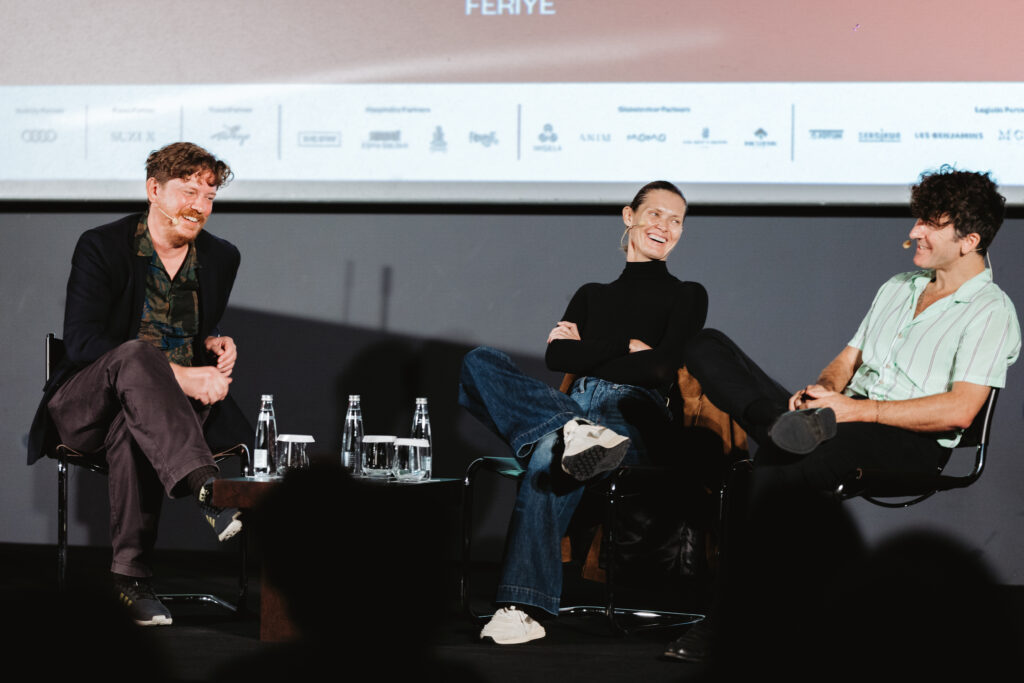
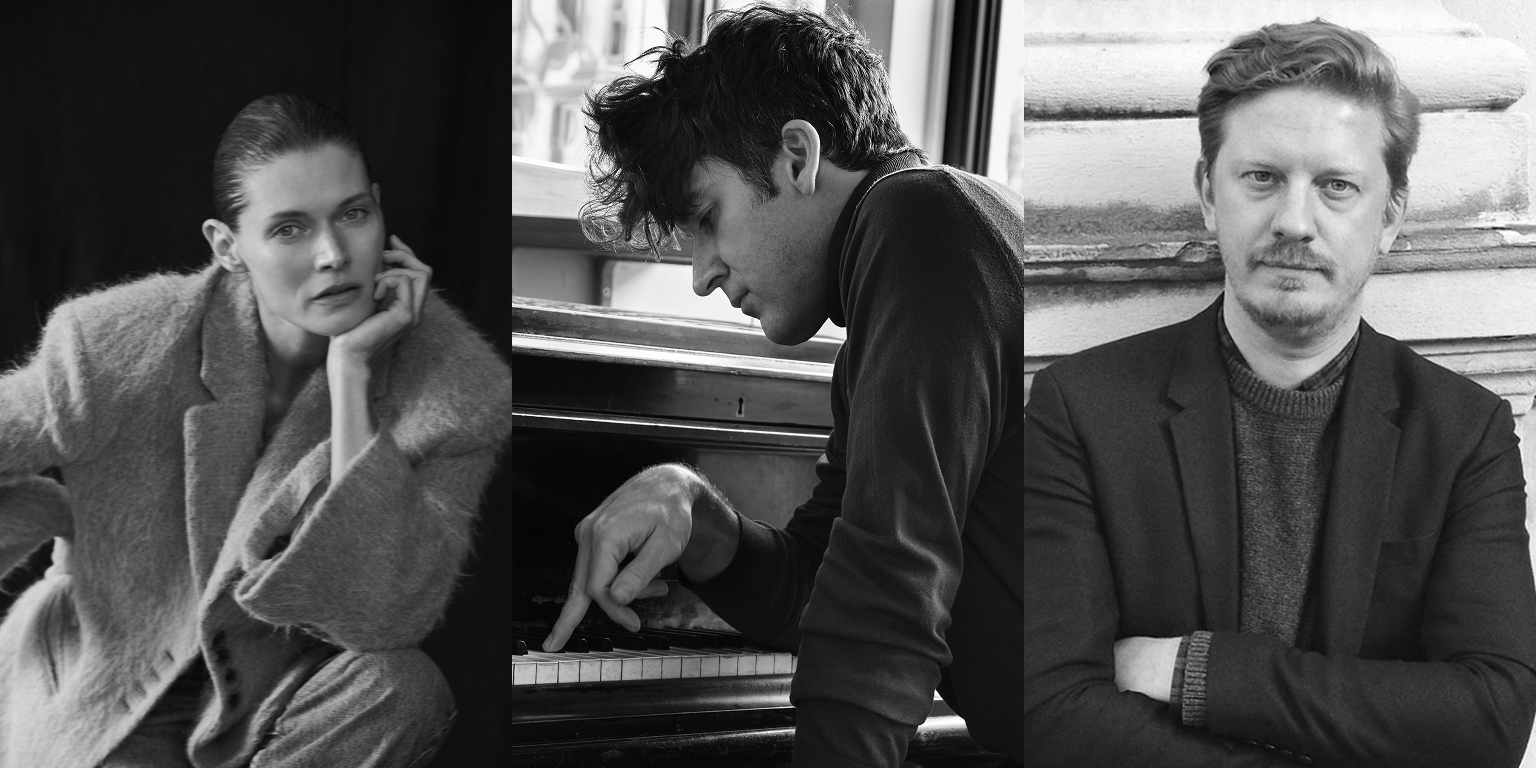
Filip Niedenthal Ladies and gentlemen, that was Marcin Masecki. This is Małgosia Bela, and my name is Filip Niedenthal, and we’re here to talk about the movie Muse, and what it is to inspire and be inspired. So Małgosia, you have been a muse to many, and you play the muse in this movie, one who takes the job very seriously. But actually, you were the driving force behind this project. You came up with the idea, you wrote it, you produced it, you got everyone involved, you got it done. How was it to switch roles?
Małgosia Bela The answer is yes. Hello, everybody. I’m not the only muse in this film. There are two of us, and this is open for interpretation and discussion. Was I the driving force? Yes. I basically forced everybody involved to be involved. I blackmailed my husband into directing it, and kind of forced Marcin. Do you want to tell the story?
Marcin Masecki Yeah, well, yes, okay. Hello. Małgosia came to a concert of mine and she said, after the concert…
Małgosia Bela And after many drinks.
Marcin Masecki After, yes. “Listen, I have an idea, but first you have to agree to it.”
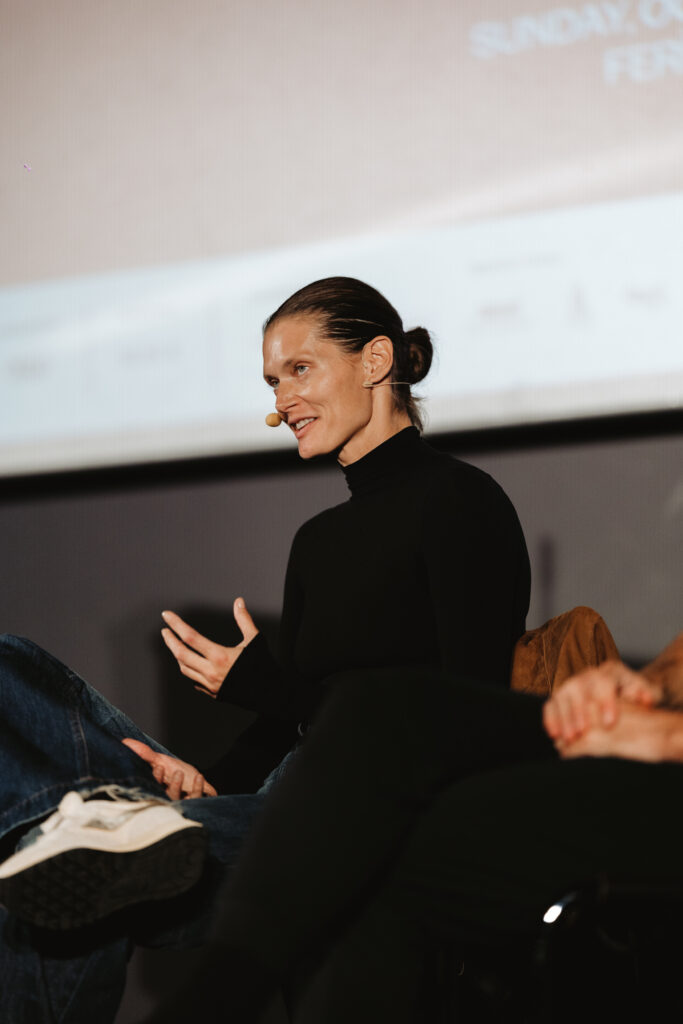
“I’d very often feel like I’m a muse, but I also balance on this very fine line of being a muse, inspiring and disturbing, and fighting for attention. And very often it’s frustrating. And sometimes it turns murderous.”
-MAŁGOSIA BELA
Małgosia Bela That’s how it was. I have a great idea, but I’m gonna tell you if you agree. And Marcin kindly agreed, because he had no choice. He was pushed against the wall basically. Yeah, but so the idea came, if I can briefly explain, from my personal relationship with my husband, who is an artist. I’m not. I very often feel like I’m a muse, but I also balance on this very fine line of being a muse; inspiring and disturbing, and fighting for attention. And very often it’s frustrating. And sometimes it turns murderous. And yeah, but the thing is, and we see it in this little film and I wanted to follow up on what Lou was saying yesterday. It’s hard to say really, who is the muse because the artist in the film really inspires the muse to do whatever she does, change, and yeah, so you’re equally a muse, like me. Amused, yeah. And we are both amused.
Filip Niedenthal Marcin, how does it feel to be the muse, and do you have any muses of your own?
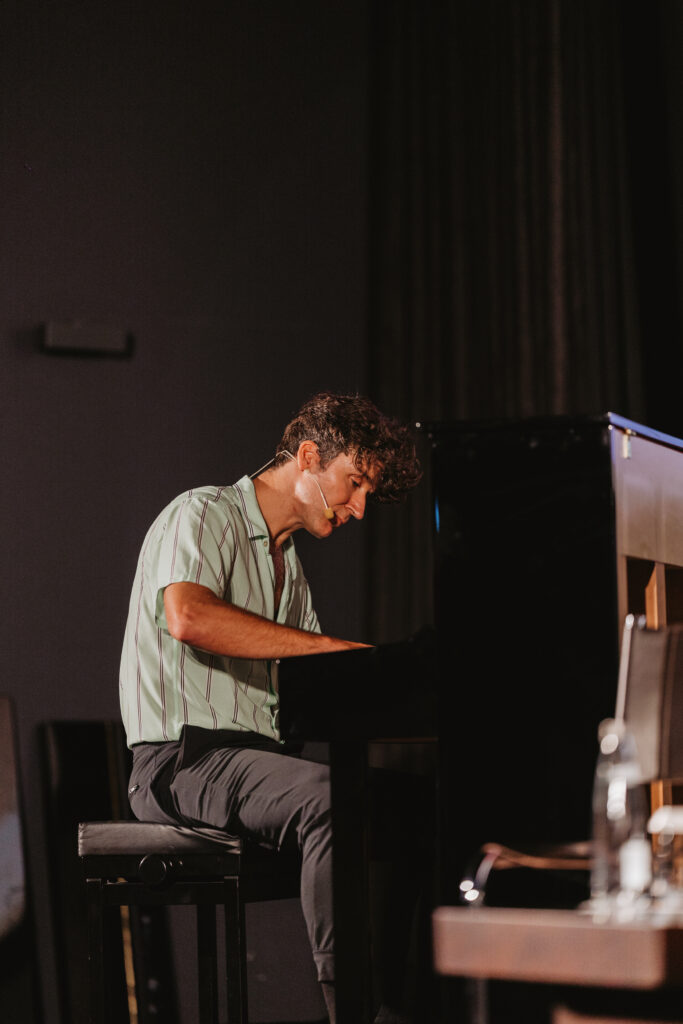
“For me, it was more interesting from a different point of view. I mean, this is an interesting topic. But I’m a musician. And I was very much in the process of making the music. But it’s true, the story came from you. So I had a certain frame. So the muse was the story. And I had to find myself sonically in the story.”–MARCIN MASECKI
Marcin Masecki Yeah, of course. For me, it was more interesting from a different point of view. I mean, this is an interesting topic. But I’m a musician. And I was very much in the process of making the music. But it’s true, the story came from you. So I had a certain frame. So the muse was the story. And I had to find myself sonically in the story.
Małgosia Bela Yeah, basically, you had to write the script.

Marcin Masecki I had to write the script, but according to a script.
Małgosia Bela And I was telling you more or less she’s going to be annoying you and then she’s gonna jump out of the window, and then you’re gonna be like she’s done that before many times, right? And your work, your challenge was to tell the story in an abstract language, which is music.
Marcin Masecki Yeah, it was very fun.
Małgosia Bela And it was, the process in itself was super fun because I gathered as the producer, I gathered everybody, all six people that were involved in making this film.
Filip Niedenthal Because you not only acted in it, but you also did hair and makeup.
Małgosia Bela And costumes. And we were on an island, so there was nowhere to get other provisions from and equipment. So whatever we had, we had. And we locked ourselves in this music studio on a Greek island. And Marcin had to come up with the script and the music. We recorded it, and then we had to kind of play the story as we were filming.
Filip Niedenthal But it was Marcin or nothing. It had to be him.
Małgosia Bela It was written for Marcin, yes, of course. It came from my personal frustration, but I knew that Marcin was the person who would channel it exactly in that location.
Filip Niedenthal Well, you’re a pianist yourself, though, right? Is that why you’re so…
Małgosia Bela I’m a frustrated pianist, so you can imagine where the frustration is also coming from.
Filip Niedenthal And the island itself and the incredible location, the Old Carpet Factory.
Małgosia Bela Yeah, I think the location, which is a music studio on Hydra, the Greek island, plays a big role in this short, very short film. So yeah, it was, first of all, it was a music studio. So we just could do, the sound was this is what it was. So the pianist was the right person at the right place, the right time. It was exactly actually a year ago, exactly one year ago. It’s its first anniversary. Yeah, exactly. It was 10th of October.
Marcin Masecki I’m just thinking about it now. It’s interesting also how the muses were the different functions and different roles. So, producer, actress, actor, musician, director, we were all kind of looking at each other and inspiring each other and taking from each other, and giving and taking a lot between different roles of the production process.
Małgosia Bela Right, so it really happened there. It was, for us, it was really real. It was happening there. There was no script. There was some kind of mood board with some pictures of Inez in it, actually. It was some kind of mood board and a rough story. And then we kind of created an environment for ourselves that was inspiring and I don’t know. But it was some, it was a community. There was, even though we did have a director, it was a communal sort of work. And very much so. Yeah.
Marcin Masecki So you’re on this island, which itself is a bubble, and then you’re in this.
Małgosia Bela Bubble in a bubble.
Marcin Masecki The studio is again a bubble, and you have three days to shoot this whole thing. I mean, I think it might be easy to blur the boundaries between reality and fantasy.
Małgosia Bela It’s funny because if you’re in it, it feels real, right? I don’t know.
Filip Niedenthal Do you ever lose track of reality in your job?
Małgosia Bela No, because the light was going, so we knew we had two hours in the morning and half an hour in the afternoon.
Małgosia Bela That was, yeah, that’s what it is, you know, the light is important, the location also, sound.
Filip Niedenthal Do you ever get lost in your music?
Marcin Masecki Well, yeah, all that constantly, of course. But I was also thinking…
Filip Niedenthal And you look lost in your own world.
Marcin Masecki I got lost there for a moment. Very close. I didn’t know what the next note would be. I was also thinking about it. This is kind of a cheesy thing, but this wouldn’t also be possible. I don’t think I would feel fine to open up and lend myself so much had it not been a very friendly thing. So we’re all friends, we’re neighbors in Warsaw, we live very close to each other. So this was an opportunity to open up. Not common in my work.
Małgosia Bela Right, usually we are more guarded, but there was an element of trust, can I say? There was a very small element of trust between Marcin who was earlier working with my husband on his previous film, so that was definitely an element of trust there.
Małgosia Bela I think there was a little bit of distrust here.
Marcin Masecki Yeah, at the beginning, I wasn’t sure, to be honest. Yeah, she dies at the end. Why? I’m not sure I dig that story entirely.
Filip Niedenthal Did you kill her?
Marcin Masecki But she didn’t die, she was supposed to die at the beginning.
Małgosia Bela Well, that was my brief, right, to make it more dramatic. But yeah, of course she doesn’t die because inspiration doesn’t die and she’s there to annoy you and inspire you endlessly until the end of the world. Yes, it was funny because I was explaining and even brought a prop here. I was like, and then she completely changes. So we have to change the mood. Then she has this like big thing and then she becomes this different person.
Filip Niedenthal Yeah.
Małgosia Bela And Marcin was like, “Oh, OK, OK. And then he did accordingly with the music.
Filip Niedenthal We were talking earlier and you said a very beautiful thing, that you were trying to describe your range, your versatility of your job in music and…
Małgosia Bela Yeah, I wanted to say that Marcin, for me, as a pianist is, and I think actually Stefan yesterday said something about music being this form of art that can instantly change your mood quickly. You know, you feel sad, you put some music on and you are somewhere else. Your mood changes. And I think he’s the magician here who can do it. And I come from fashion, where actually, especially the hair changes the character also. So you go with one, with one graphic movement or a wig or lack of wig or hair pulled back or I don’t know, suddenly a lump becomes a heart. Also, it’s that versatility that I have as a model, I hope that he has as a musician, as an artist, that film was an attempt to combine those two. And tell a very universal story.
Filip Niedenthal And how you’ve mentioned that you are friendly, you’ve been friendly for years. How has this project affected that relationship?
Marcin Masecki Our friendship?
Filip Niedenthal Your friendship and your working relationship. I mean, can we expect more projects like this?
Marcin Masecki Well, that’s a question for the producer.
Małgosia Bela It’s brewing. How has it affected our friendship? Only for the better, no dramas.
Marcin Masecki I’m working now on Paweł’s new film, coming up soon, 1949. I think it can be said, I just said it.
Małgosia Bela You just said it, so it has to be said.
Filip Niedenthal You heard it here first.
Marcin Masecki And yeah, let’s all collectively push Małgosia to come up with the sequel. To Muse 2!
Małgosia Bela The pressure is on now. No, but it was that work in a very small community being locked in one room with those changeable aspects, like you know with the light with the sound and I don’t know it’s honestly it was pure happiness for me and I have to say no it’s gonna sound cheesy but but when I’m sad I look at this and it’s just it’s Just the sense memory, I guess, always. Brightens my mood.
Filip Niedenthal Does it inspire you to do more?
Małgosia Bela Yeah, but we are talking about that now, this is really real and –
Filip Niedenthal We want more. More from the muse.
Filip Niedenthal That’s very good that you watch yours, that when you’re down, you watch your own creation and it lifts you up.
Małgosia Bela But I don’t treat it as my creation. That sounds terrible.
Filip Niedenthal No, it’s good. It’s great. Do you listen to your own records to lift your mood? To get out of a slump?
Marcin Masecki Well, I was just listening actually to a… Yes, it’s possible. I was listening to a recording I made 13 years ago of Chopin’s music. We have the Chopin Competition in Warsaw now. It’s a big deal for the piano world. And I recorded a very audacious version of Chopin’s music 13 years ago. I listened to it yesterday and it made me smile. Are you talking about the nocturnes? No, I’m talking about this deconstruction of Chopin’s music, which is beautiful and subtle and delicate, and I made a very kind of nasty, ugly thing out of it, not nasty, very uncomfortable, and it gave me a lot of joy.
Filip Niedenthal Well, I remember you used to drive the music critics in Poland wild by insisting on playing on this dinky little piano that was untuned. That was kind of your muse, too. You traveled everywhere with that piano.
Marcin Masecki Yes, I like the imperfect. I like these upright pianos versus grand perfect pianos. I like to find inspiration in the stains of things.
Filip Niedenthal We’re going to be wrapping it up soon, but the question on everyone’s lips and every panel has been the use of artificial intelligence in art. So the obligatory question, how do you see this working for you or could it?
Małgosia Bela I don’t see it yet, but the moment may come. For now, I’m just not. Marcin has something to say about AI.
Marcin Masecki I don’t use it. I guess I’m old-fashioned. It hasn’t reached me yet. Yesterday. My 13-year-old daughter pierced her ears, and she was very afraid of it. The needle and the thing. And then she seemed better when we were on our way, and I asked what had happened. And she said, “Well, I asked ChatGPT to give me a pep talk.” So ChatGPT gave her support, emotional support.
Małgosia Bela So yeah, it’s a useful tool. My son is too old for the PEP talk so…
“I mean, you guys don’t use AI, but AI could end up using you. I mean we’ve got digital actresses, digital models, you know.”
–FILIP NIEDENTHAL
Filip Niedenthal I mean, you guys don’t use AI, but AI could end up using you. I mean, we’ve got digital actresses, digital models, you know.
Małgosia Bela Getting there, yeah.
Marcin Masecki It’s coming.
Małgosia Bela We have a note.
Filip Niedenthal Yes, I think it’s time for questions, if we have any from the audience.
Małgosia Bela Yes, I’m blinded by the light.
Filip Niedenthal Well, so is Timothée.
Timothée Verrecchia Hi everyone. What’s gonna be the life of the movie?
Małgosia Bela The movie has had a little festival run, and then it was actually bought from us as a ready product by MUBI, so it’s available on the MUBI platform. That was a nice surprise, but they loved it, and they showed it, so why not? And then, yeah, we showed it at some festivals. We showed it at a film festival in Croatia. We showed it at the film festival New Horizons in Wrocław in Poland. And had some screenings on the way. We had a great screening on Hydra, where Demet saw it for the first time. So, you know, for a six-minute film, I think we are quite satisfied. There was never any calculation involved. I just wanted to get it out of my system.
Filip Niedenthal Thank you Malgosia, thank you Marcin.