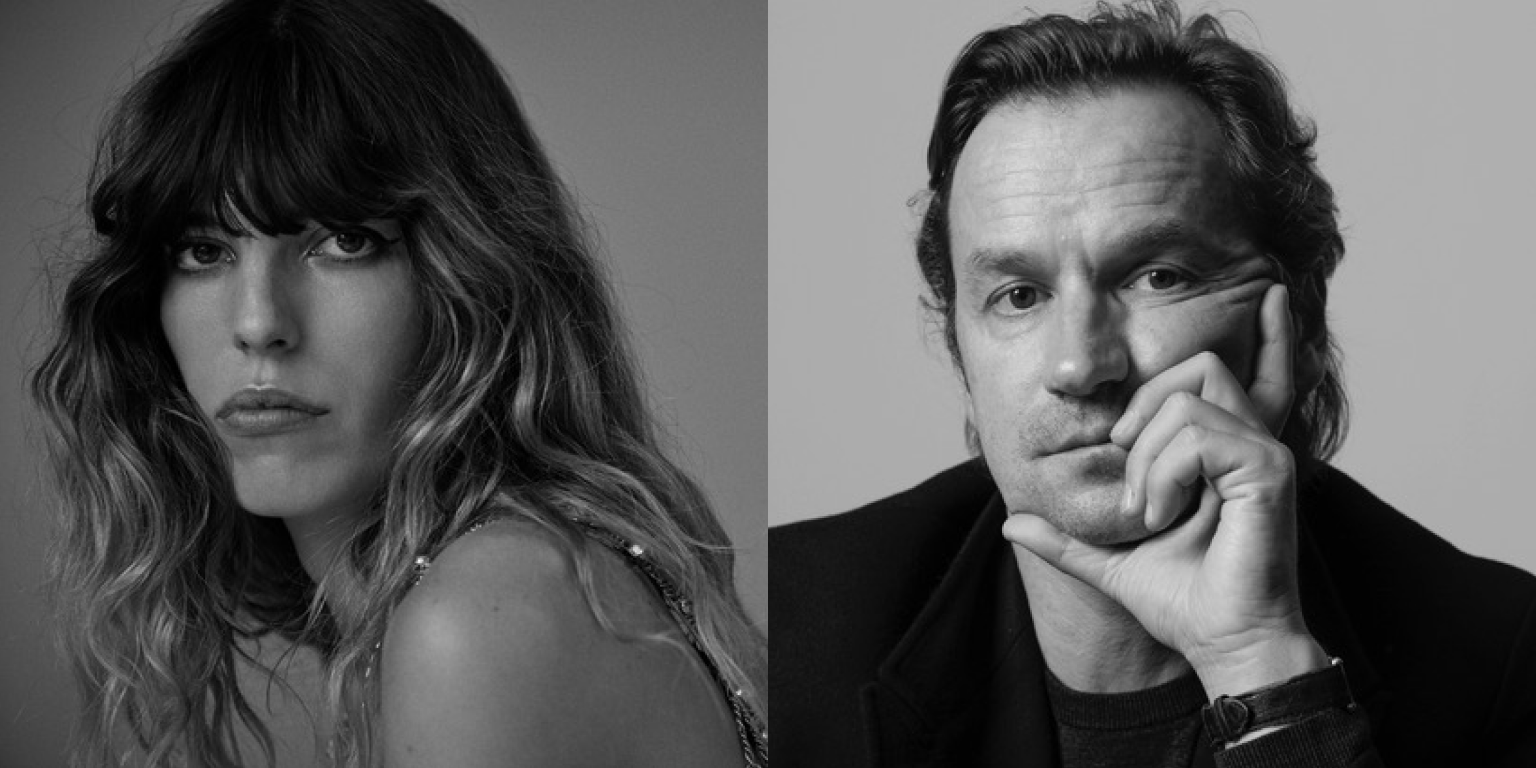
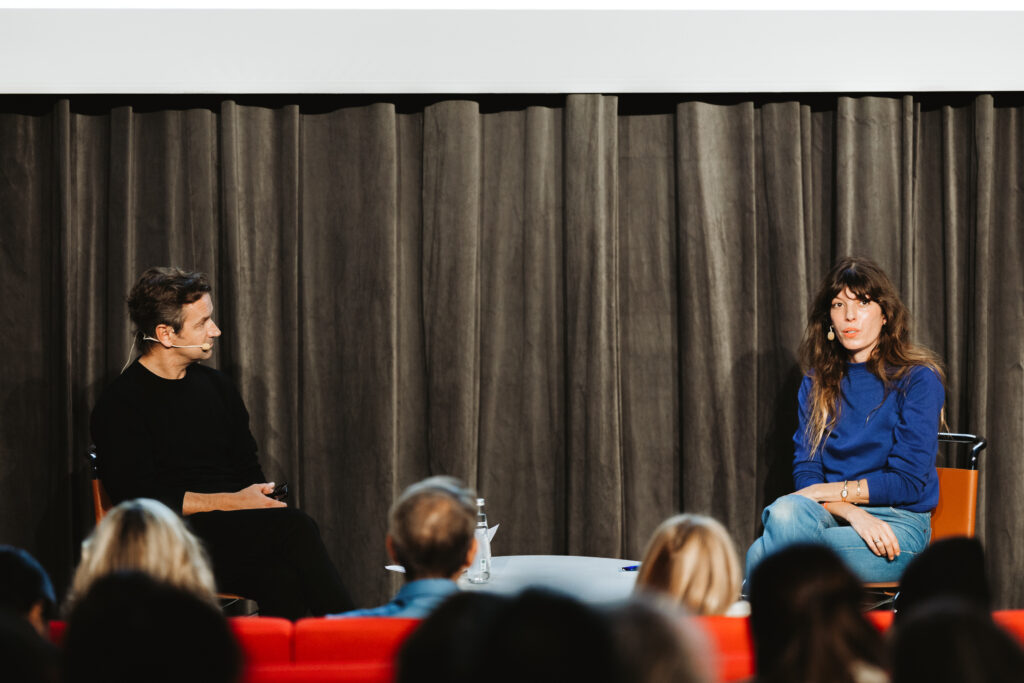
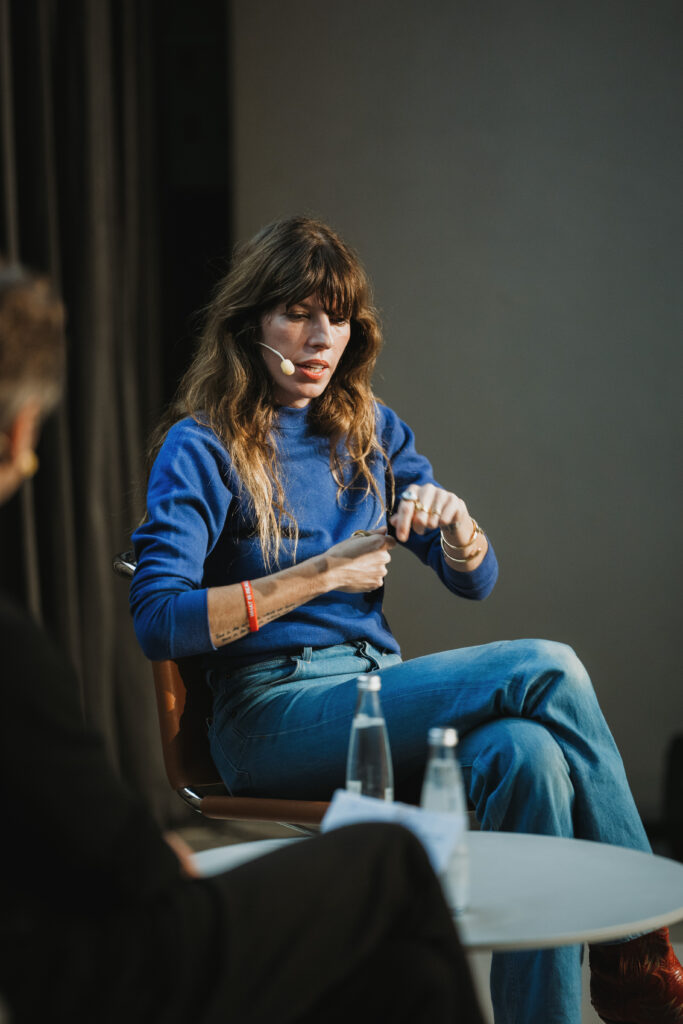
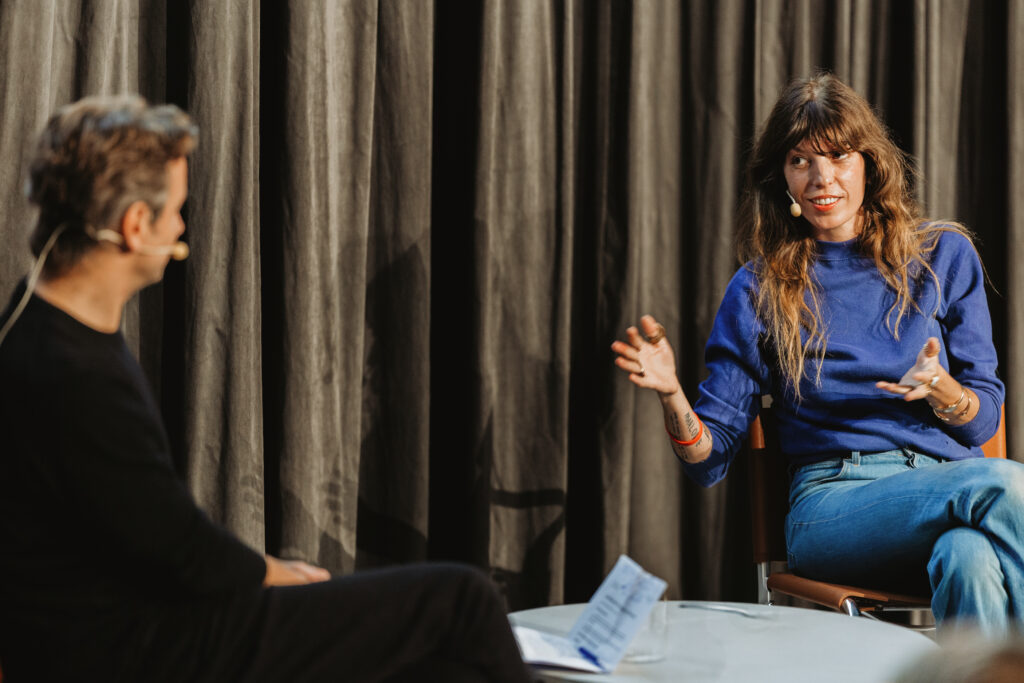
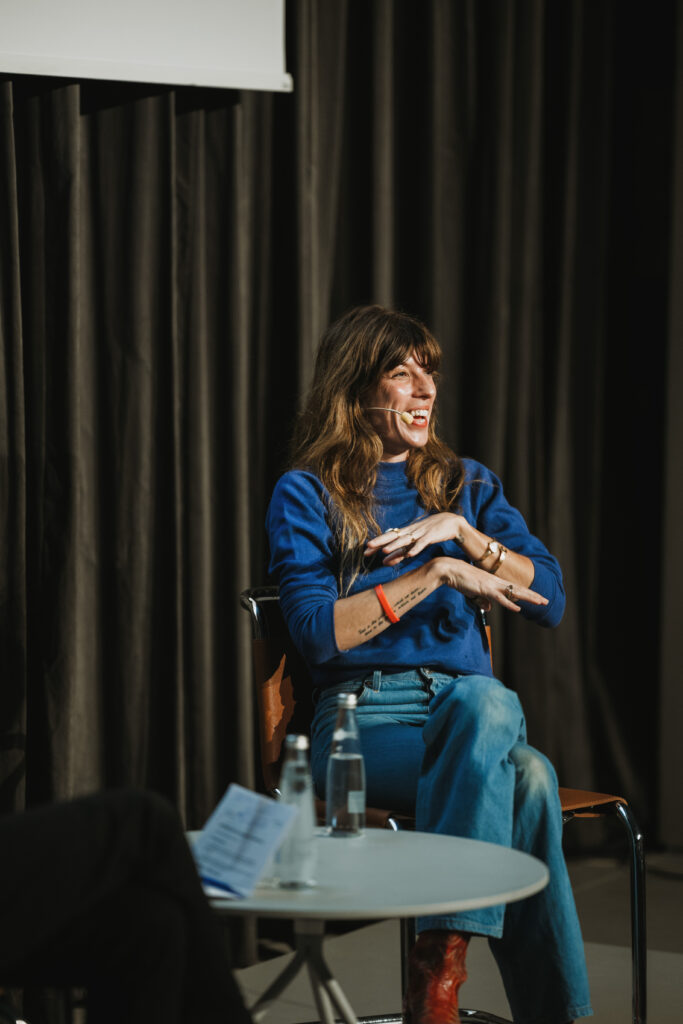
The third panel of the 15th Anniversary Edition of the Istanbul International Arts & Culture Festival — IST.FESTIVAL — featured a conversation between Lou Doillon and Timothée Verrecchia, titled Between Song and Silence: The Fragile Real of Performance. Doillon shared her perspective as a multidimensional artist, exploring how performance and voice navigate intimacy and exposure. Together, they reflected on how the act of performing can reveal a delicate yet undeniable truth in a world often preoccupied with perfection.
Timothée Verrecchia Hi.
Lou Doillon Hello.
Timothée Verrecchia Thank you for being with us, Lou.
Lou Doillon I’m so thrilled.
Timothée Verrecchia I’m so excited.
Lou Doillon And the pressure is on after such wonderful Jeff just opening all of my vistas. Stefan, and so what I love is that this kind of dialogue has started. It’s like this chain and hopefully I’ll be able to get in the chain and then send the chain to, is it Benjamin right after?
Timothée Verrecchia Benjamin.
Lou Doillon There you go.
Lou Doillon So.
Lou Doillon Well, let’s.
Timothée Verrecchia It’s like a family affair, I was telling them, it feels like a high school reunion.
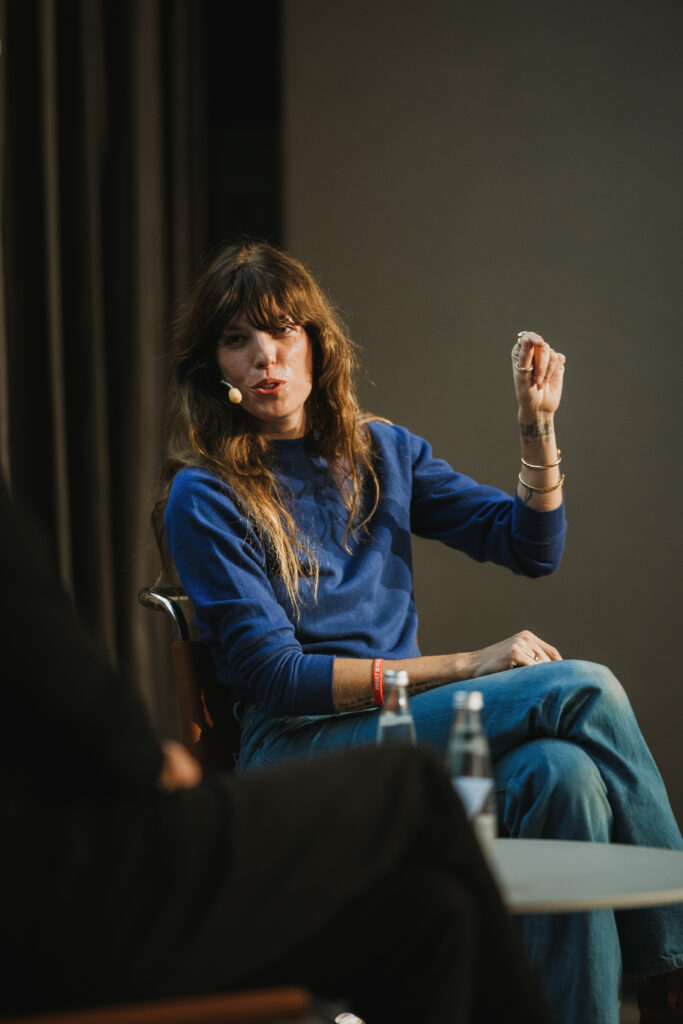
So, I feel like a little girl today, finally in something that resembles the best school ever, with the best teachers giving tiny, kind of condensed master classes.
Lou Doillon It’s very lucky, because I might be one of the only ones here who not only didn’t go to the end of my scolarité, as the French say, but I’ve never been to art school. I’ve never had any form of training or discipline, and I have always, like anyone who hasn’t done it, worshiped art schools and worshiped the fact that you could have wonderful, creative people who would share their knowledge. So I feel like a little girl today, where I’m finally in something that resembles the best school ever, with the best teachers giving tiny kinds of condensed master classes and, yeah, thank you.
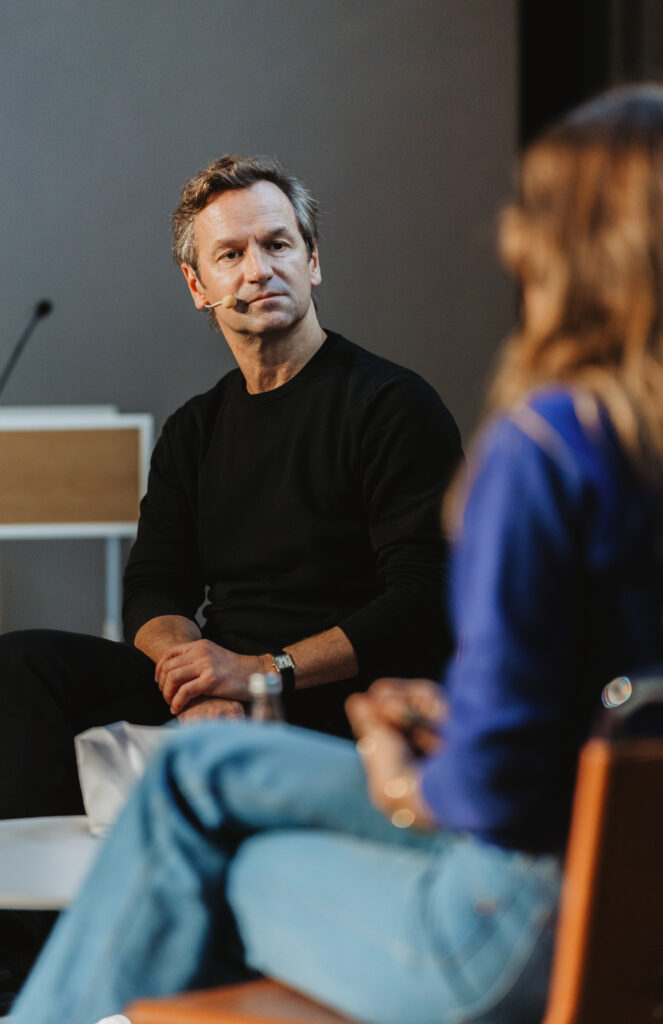
It’s funny you mention that, because for me, you are the quintessential artist—you’re so multi-talented. I’m always listening to your music, looking at your drawings, listening to you read and write poetry, doing all kinds of things, and you’re constantly creating. So, I know you don’t consider yourself an artist; you consider yourself a human being, essentially.
Timothée Verrecchia It’s funny you mentioned that because for me, you are the quintessential artist because you’re so multi-talented and I’m always like listening to your music, looking at your drawings, listening to you read and write poetry, do all kinds of things and stuff and you’re constantly creating. And so I know you don’t consider yourself an artist, you consider yourself a human being, essentially.
Lou Doillon For sure, for sure.
Timothée Verrecchia And you’re just constantly creating, so. And that’s essentially kind of my first question for you. It’s because you sit across so many different things, you’re constantly using your hands, using your voice, making music, all kinds of things. You sit across all these different crafts, like how did you find yourself across all of these crafts? And would you consider yourself an artist?
Lou Doillon I don’t know, we’re always very embarrassed by this question of being an artist. I guess that I’m lucky enough to sustain myself thanks to what I do and that makes me free and free to do what I want to do. That is huge, that is massive and I’m very proud of that. I guess that I would consider the obsession having to do with observation. I’m of a very curious nature and I love to see people. I love to see what people do. I love to see how they do it. I come from a strange background, which is that I come from a very famous family, which is of no interest whatsoever. What’s interesting is that as a child, I was constantly looking at people, looking at them. If you’re not famous and you’re next to famous people, you don’t exist. So I was a wonderful insider. I was under the table nearly till the age of seven or eight. I used to draw the feet of the people under the table and I could see their hands. They were very famous people. They were very important people. And I loved to see how it would communicate or not with what was happening with their legs and with their hands under the tables. See people who could have seemed very relaxed and seeing their hands completely freak out, or my favorite gesture of women who do that was their heels or that whole intimate side, l’intimidité, something of what we give out, what do control, what we do not control, and what people project. It was fascinating as a child to be on the side of the stage and to see all the emotions that people were living through people that I knew. Who were also living what’s private, what’s public, complicated lines, a bit like what’s real or not. All of this seemed to be like a kind of show that was going on, and so I guess that put me in a position of l’observation, which I adore. And so in the drawing, it’s obviously there. In the reading, it is there because for me, Words have a lot to do with sound. I think poetry should always be read out loud. Clearly, some poets were having fun with the resonance of words. Sylvia Plath clearly chose words because they had a violence to them. They had a thing and they had something going on. All of the kind of the sound of words, that breathing of a drawing, that all of it, weirdly enough, keeps on resonating in me to a state of great confusion today. I can write a song because of a pair of boots that I like the sound of those boots because which reminds me of the boots that I saw in the Van Gogh Museum when I was a teenager. And suddenly you think, oh, but then it brings me a song. So am I buying the boots, to draw the boots to make a song with the boots? So then I don’t know at this point. I know that they’re like little glitches that I’m trying to weave. And also, I guess, it’s what we all have. I love hands and legs and feet and the embarrassing moments of people. I love our cheapness. I love shitty little moments. I think I have a passion for… How beautiful we are in those moments, even if they’re not beautiful moments, we all have the same. And so to be able to be a witness of that, I guess, yeah, all my work has to do with something which is common.
Timothée Verrecchia And I think all your work, I mean, what’s interesting, what you’re saying is that all these different art forms are ways for you to transcribe what you are observing. And so I’m sure they all have a difference; they all refer to a different internal process, the way that you compose music, the way you write music, the way they draw, all these things. So how does that, you’re seeing it’s a form of chaos, but I do see that the way you put it out into the world is also very, it’s very thought out in the sense that these are different layers for you to divulge the way you process things and the way you divulge your own intimacy.
Lou Doillon Yeah. There are a lot of rituals. I’m very worried. I’m worried that I haven’t got time. I’m really worried that I’m wasting a lot of time with stupid shit. I’m wary and cautious of everything around me, so if all goes well, yeah, a day should ideally, once the children have been fed, that the dog has been taken out, whatever, to write in my diary. I’ve held a diary since I was 12 or 13. So there’s half an hour of that, putting down maybe the dreams, maybe the weird, chaotic things, ideas, not to let the world come in at all, if possible. And then there will be a feeling, and the feeling can either be something that needs to be processed on which I guess I would tend to draw that it would be a way of thinking and obsessing, and following a line. I do very strange drawings, which are hard to understand without the process, but it’s, I only draw what I see since I was very young. And so it’s this because I like the way no one else ever sees it of ourselves, and it’s completely wrong. It’s the thick thighs against the table. It’s suddenly the shortening of the foot. It’s constantly, sadly, the left hand, because I draw with the right, but it’s… That doesn’t move, and at the same time it’s moving. Now I see their hands are aging. They will, I was lucky to have, as a marraine, Agnès Varda, and Varda we used to lie down when I was small and we used to look at our hands, and she was like, this is the last thing you’ll have. It was the first thing you had, and it’s the last thing you’ll have, and I thought, yes, I’ll draw that all my life, and I can see it changing. And if all goes well, my craft will be in my fingers and it will finish completely diminished, and hopefully, I will still be able, you know, I have to draw everything like that and that’s it, I’m 43, I can’t see shit here anymore. And I’m like, how is it gonna work out to just testify on something as simple as pen and paper, just testify that I was once here. I think that’s what we all feel and need. Which is a strange relationship, that’s what was beautifully said about AI, that a lot of what we do has to do with the emergency that we’re gonna die. I think that insane fatality is something so moving that you think all of us, every single one of us, are gonna die in pretty shit circumstances, whatever happens. If we’re lucky to die old, that means we will see all of the people we love die before us. And this kind of insane deal, which is the only deal when we get on this planet, that’s the only thing we are absolutely sure of for the moment. And we all manage to smile and kiss and say hello and make love and want to go on and take the dangerous act of loving, making, creating. When you know that it’s all gonna go. I think that common ground between all of us is what makes me wanna testify. Testify about the smallest thing, testify about songs. What do we only sing about? Love. What other thing could you sing about? You’re either losing the love, looking for the love, finding the love, hating the love, saying you don’t care about the love because you care about the love. It’s love. That’s the only message in music. It resonates and that’s it. And I love the petite scale of it for me.
Timothée Verrecchia Mm-hmm, but it’s so it’s not just about observing it’s also about sharing, right?
Lou Doillon Yeah.
Timothée Verrecchia So much of it and then you know as you mentioned, you grew up with that language with that natural language of observing and creating and singing, writing, and drawing. What was the impetus for you to start sharing? You know to start putting your work out into the world. And start sharing your drawings, the music, everything. What was the turning point?
Lou Doillon I guess it was the weird tool that is Instagram. I started off acting for a long time. And who I was was defined by journalists, good or bad. And a lot of things have changed in the last 30 years. But I can tell you that 25 years ago, to be half French, half English, model / actress was kind of the lowest you could get respect from journalists. I mean, I don’t think there was anything lower than that. So, you know, it was just like, you were a tool for other people’s creation. And I think no one, I remember the first time my first album was released. People couldn’t believe it. Literally all of the press was like, we didn’t know you could write. We didn’t know you could sing. Wait. We didn’t know you could think. And well, thanks to Instagram suddenly, it was a way for me to control the fact that I could send off how I saw the world. The fact that, yeah, it’s stupid rituals. Every morning, I take a picture of my breakfast because I love eating, love breakfast. Then it will be the diary. Then, hopefully, it will be a drawing or it will be a song. If I’m on tour, it’ll be the moments before going on stage. It’s the duel between, yeah, that terrifying moment where suddenly you’re gonna be out into the world. But so all of that came thanks to Instagram and gallerists and curators suddenly approached me for that work and now I’m lucky to be in a world where in 2025, to be a multi is starting to be cool. But from, you know, I’m half French and in French people always say, you know. What’s the terrible expression that I was told all my childhood? It’s good, I’ve blocked it out. I think I was 14, it was one of my first TV interviews saying, oh, “You do many things because you don’t know how to do one well.” So, yeah, fine.
Timothée Verrecchia Why not right but so much of so that era opened up a way for you to open up your knowledge of your work, your intimacy. What’s the? How do you gauge how much of that intimacy you share with the world because I know you have a very very colorful inside world and again, we see your music, your drawings, but like how do you what is the? What are the filters and you know in terms of the layers that you divulge to the outside world?
Lou Doillon It’s extremely instinctive and at the same time, it’s a very hard question. I don’t really know. My mother had no filter whatsoever between public and private. Bless her, that was wonderful. As her kid, it was confusing. And I guess that’s why I was also very attracted by the work of Sophie Kael was the idea that I like the idea that you can control the vision that you’re giving of what’s intimate or not. And that you can actually make something with it and that you’re going somewhere with it. That if you’re gonna share things that might even hurt the people around you, then it better be for a direction of work. I guess that I’m trying to navigate on a thin line, which is that what’s extremely intimate, most of the time is universal. And I do love that. I would say that I would have no problem sharing a drawing of me from above, maybe the boobs looking weird, maybe I did all my pregnancy, I did the nine months of insane transformation from there and sometimes it’s not pretty. I did the whole thing till going to the hospital and in the hospital and breastfeeding and the whole animal side of it. For me that’s absolutely fine. I would say that a dinner party with six friends at home would make me extremely embarrassed to share. So weirdly enough, you can see things that would be considered by some people extremely intimate, but I don’t think you can actually know much from following my Instagram about what who I’m actually living with what I’m doing or vaguely there’s bits of hands of children, there’s bits you can feel that there’s children and animals, but it’s a kind of blah blah relationship it has to do with more of with a vibe, I guess, all those wonderful new words, it’s storytelling, you know, whatever. But so, it was extremely intimate that I would be able to talk for half an hour about how stupid I was, how stupid I can still be, how we have bad instinct, how in a breakup I was destroyed. I mean, very, very intimate things. I love sharing, because I don’t care. I think that it would happen to anyone. And, and… So that for me is common.
Timothée Verrecchia And as a public figure, do you find that you know precisely this whole Instagram era that we’re in has kind of blurred the lines in terms of intimacy? I know that you enjoy very much playing on stage, being on stage and that’s another form of sharing intimacy. Do you find in the interaction with the outside world there’s ways where you lose control of that sharing of the intimacy?
Lou Doillon That’s the thrill, and I would say that’s the thrill of being on stage. It’s the idea that if all goes well, being onstage is a very strange balance, I find, of an ultra-ego, which is, of course, everyone came to see me and my songs, and a complete lack of ego, which is that no sane person would ever go onstage in front of other people to do something that they might miss. Most of the time I was an acoustic guitar. If I fuck it up everyone will hear if I’m not the greatest singer of all time I can do what I do. That’s about it. I can’t do more than that and so it isn’t to show I’m not there to bluff anyone. I don’t think people come out thinking. Oh my god. I want to be her. Hopefully it’s the other way around. It’s what moved me when I was younger to see people on stage. What moved me was the completely irrational idea of being able to to be a kind of antenna to feelings. Because actually when you are on stage, when I’m singing a song of mine, the most famous, like if I’m singing I See You, what’s beautiful is that I’m in front of people who know this song much better than I do. I wrote it, took me the time it took, was actually that one pretty quick, recorded it, and just sang it four times. Since then, I have sung it 90 times, maybe 150. I’m clearly in front of people where some of them have listened to the song more than 200 times. What’s wonderful is that they’re looking at me, but for real, I don’t exist. I can see it in their eyes that the eyes are nearly going backwards. They are where they were when they listened to that song. They’re back. Where’s their breakup? They’re backwards. Where’s they’re love story? I don’t know where they are. So in fact, you’re on stage and everyone’s looking at you, but to be honest, they’re looking through you. They’re actually looking at themselves. They’re looking at the relationship they have with the songs that you’ve given. That is an absolute thrill, because it’s a moment of… pagan necessity. I think it must have been one of the oldest things we ever did to sing together and to make rhythm and to dance. Must have been the first thing. Touch, kiss, all of this is terribly ancient. So this part of not controlling I find not only fascinating but that’s the reason I do it and ideally, I would rather be on stage all my life with an audience maximum their size to be able for something to happen. The idea of a perfect performance from far away that will be the same every single night, for me is no fun. I like the idea, but because I’m like that as an audience. The idea that everyone’s gonna see the same concert as mine pisses me off. I want something special to happen tonight because I am coming to see you. And I want it the other way around. I want people to be able to… yeah, for us to live a moment, ideally without phones, ideally without anything of just, this is one of the rare jobs where nothing is going to come out of it. It’s going to be there, it’s going to be there. But that’s it, there’s no image of it, there’s nothing of it! If I write a song, which is insane, I can hum a melody to you. It’s nowhere. That melody can travel throughout the world without even being recorded. It’s just that to work with this wonderful nothingness is maybe the most exciting in the world of today where everything needs to be quantified and physical. I’m in an industry where now people are wondering if creating an album even has economic sense. And you think, wow, it’s just hovering around. And I guess that that absolute lack of control is wonderful. It’s a thrill because we do control Instagram. We control our image at so many levels. And it’s an illusion.
Timothée Verrecchia Yeah, no, and I think what’s great with you is that you have so much knowledge and so much experience and have experience in so many different ways. Those languages, the commercial aspect of the work, the industries that you’re in, but so much of your energy is really immediate and impulsive and urgent in the way that you communicate with people on a daily basis and the way that you like to communicate your work. So much of it is about almost the physical exchange of the arts. And I know that you, not that you struggle, but I do know that the commerce aspect of your work is also something that you grapple with because it is real.
Lou Doillon Yeah, yeah, yeah. It’s, I mean, enthusiasm is a great thing and to get excited and giddy and to have a big smile does get, you know, make you travel really well. You can kind of pave your way through because it is thrilling. I’m lucky to, you know, that was maybe the good thing of having parents who were so obsessed by their work, obsessed really by what they were doing and what they were doing was so interesting that for sure that coming back home to cook for the kids was way less interesting than what they were doing. And so they never really looked at us, which means that as children, I wouldn’t recommend it as a parent, I don’t know, but as children we were really left with our own imagination versus boredom, I guess. And when I was five or six, my uncle who’s a very wonderful, interesting, weird artist called Andrew Burkin. I told him, I said, oh, Andrew, I’m bored. And he said, no, you can’t be bored. It doesn’t exist, you’re just boring. And walked off. And I thought, that is the last time I will ever be bored, you know, no one will ever catch me bored ever again. And so I used to go into rooms, count how many windows, count the tiles, count that there was a problem on the ground, try to memorize every single detail, draw with anything that was available. Learn everything I could, go to every factory possible. I do collaborations in fashion just because I’m obsessed with the craft. To be able, you know, I did boots with egg because the only fun was to go and see how you make boots? What does, you know, a couch or factory smell like? What does it look like? I did jewelry with Arthus Bertrand that’s coming out in a couple of weeks to see the machines. They have an actual machine that makes the medal with La Vierge Marie. It’s one machine, like a kind of insane Dr. Seuss machine that goes bloop, bloop, bloop and it starts like this and then comes out a Virgin Mary and you think, I mean, you know, it’s the thrill, the thrill. And everything, when you see anything, how anything is built, is just insane. The fact that there’s been, and in our world, and we know it was the world of commercials and you know when something’s really bad and you think, “ah!” They’ve had 30 reunions about this thing. There’s been, you know, they’ve had so many reunions and that is the result. I want to meet these people. It’s just, you think, you know, we live in a world where everything has been done, crafted and I do believe that as humans, we feel when it’s been done with love. Or instinct. Instinct and what I thought was absolutely beautiful. Is the idea of care that Jeff so beautifully talked about. You need to care. Everything I do is because I care. I do not see the point of doing it for any other reason. And one thing links to another that links to another and you just have kind of fireworks in your head when suddenly you think, oh, this and that, and on any subject, on anything, to meet any person that masters a craft. You know, to see the oldest technique of making miso and to see that the guy who makes miso knows when it’s ready because he hears it. A majority of crafts that have to do with food are actually heard or touched, not taste. You think this whole, I mean, I wish I could be around this planet for, do you know, another hundred years and I wish I could be many different, you know, in many different places. I wish I could be in many many different genders. I mean, and that’s where literature comes in. Thank God for literature, which is, you know, us being able for a moment to live in the shoes of somebody else, to have another point of view, another vision, but I love us so much. And of course my heart is broken by how stupid we still are, but. I think that’s because we think that we’re better than we are, if we could just accept that we are way more about territory, fear, instinct, sex, lust, jealousy, I mean…
Timothée Verrecchia Violence.
Lou Doillon Ultraviolence, that’s why I’ve also worked with my hands. This thing, thanks to those two, we can make. We can care. It’s how we touch. It’s the last thing that we do when people go. It’s that it’s the holding. It’s the grip. It’s touching. It’s taking care. It suddenly became, with COVID, the danger. It was this that you slap, that you beat, that you knife, that you shoot. It’s with this that you touch a body, it’s with that you wipe your ass. I mean, it’s just this insane tool, exactly like new technologies. We are the one controlling what we do with this tool. It’s the most beautiful tool, and everything around us has been made with this strange tool. And it’s the best thing in the world.
Timothée Verrecchia On that note, do you think that the artist has a special responsibility to speak to the, you know, you speak of the pressure that you, not the pressure, but the attention that you get from your crowd when they expect you to, you know interpret or give them something that they came for. But you feel that, you know, the stage after sharing your intimacy is actually to take responsibility on certain topics, I mean you and I speak often on you know, the state of the world that we’re in and you know the society and the state of things. Do you feel that as an artist you have a responsibility towards a lot of these issues?
Lou Doillon It’s very complicated. I think that there’s… I think that there’s a variety of people, a variety of artists, and a variety of days. I mean, some days yes, some days no. I don’t know, it changes. I don’t feel entitled. I don’t think I have any form of knowledge that would give me any form of entitlement to say anything. I’m extremely cautious of morality. I don’t really know what it means. Even the notion of good and bad I’m kind of cautious about. I would say that I do not have a responsibility apart from my responsibility as a human being. That is a massive responsibility. To be an artist for me doesn’t add or take away from that responsibility. But that’s extremely personal. Also, I think that… That I like the idea of a dialog, and that today, the more it goes, the more, it’s kind of one speech versus a speech, and that I would rather keep on the dialog. So I like that magma of not being completely clear. I’m not a political person. I am in my life, but I mean not as an artist. And it can change. My mother was wonderfully implicated. She was a real, real activist, as we say too much today, and maybe too loosely. But that was deeply in her character. I think that, and actually it was on a day-to-day basis that it was the most beautiful to witness, more than statements. Statements can be very complicated. Things turn against you, things. And also, we very seldom have the actual… knowledge, the kind of zoom out, zoom out to know. And I do believe that people are very smart and that they do whatever they want to do. I can already see it with my children. And so the idea that I would tell anyone how they should think, act, or live, I find extremely complicated for me. I don’t like that. But I’m super happy, some do, and in a way it has to be done. But I guess that to care… to see, to watch, to notice, to give maybe our doubts, fear, bad sides, if that can just calm people in front to think, you know, if talking about the fact that I often feel like shit and like the worst person, that I don’t feel like an artist, that I feel like a complete hoax. That all of this is bullshit, that if I wasn’t, suddenly if it can make other people go, wow, I have that feeling too often at the time. You think, well then that was worth it. That was worth just… to be vulnerable, I guess, to be extremely vulnerable and human and confused and lost and stupidly hopeful is my way of still believing and sharing is a big word. I don’t know what we share. And also it’s a good thing to accept that you can be a disappointment.
Timothée Verrecchia To yourself or?
Lou Doillon To anyone.
Timothée Verrecchia To anyone.
Lou Doillon You know, there’s a great generosity in allowing people to think shit about you. You know, that’s okay. I give you that gift of you to think whatever you want of me because you know what I can do nothing?
Timothée Verrecchia But in a world where everyone can communicate with you, you know, back and forth. And again, you’re so, you know, forward and immediate in the way that you communicate with the outside world. How do you protect yourself from that?
Lou Doillon Hmm, you do and you don’t. I guess that the place that would be, and that would be another kind of topic, the place I find complicated maybe today, maybe as an artist with big brackets, is the fact that I do believe that was this whole morality game going on and this whole righteousness. I often wonder if we are the first generation to censor ourselves while we’re making. I think that for a long time censorship was outdoors, which meant that you would find and develop tools to kind of work around it. I’m frightened sometimes to see how as I’m writing a song or as I am doing something, I’m wondering if I can. I don’t like that feeling.
Timothée Verrecchia And that’s a recent phenomenon.
Lou Doillon I should think so. I should think so. I think, I mean. The bliss and innocence of the generation of my parents, you think, wow, I mean, you just were all kind of, you could obsess over anything, good or bad or whatever. I mean who cares, but you have no sense of, you know, what are people gonna say? What are they gonna think? Are you responsible, you know? If you write a song about something extremely dark about you, what does it mean? Are you exploring it? Are you exploiting it? How does it, you now, it’s… Can you laugh about it? Can you not laugh about it? Can you talk about something that isn’t your experience? Are you limited by your own experiences? What do you know about your own experience? I mean, all this stuff doesn’t make my work more interesting, sadly. And I guess that that is something I try to kick out of the room, where I’m like, you know, you’re allowed to do it. You’re allowed to feel whatever you feel. And as long as you’re not hurting anyone, which I don’t. Physically, that’s the lucky thing we have in those jobs too, is to think that there are so many jobs where other people’s happiness depends on you. I’m extremely lucky that apart from the people who are in my house, I have no form of responsibility. I’m not in a chain of other people, like most people on this planet, who have the terrible actual responsibility of life. If I bring out a really shitty album, no one’s gonna be in trouble you know, apart from me, technically everyone will have the same job at the end of the year, they’ll go to the same holidays, everything will be fine. So that is an actual freedom that I love. And I would say the responsibility, hopefully, is towards myself and the rest.
Timothée Verrecchia So one question for, one last question, something told is, you know, just because you, I think you really insert yourself in, you know, various artistic traditions, you know, literary, you know, music, musicship, musicmanship. Would you, I have to ask you the mandatory AI question. What’s your take on AI?
Lou Doillon I’m going to sound like a very old granny. I’ve never done it. I don’t know. I get even confused with the words. I thought ChatGPT was an automobile game. It’s not, obviously, but no, I’m really lousy. And where I’m lucky is that I don’t like technology very much, and it really hates me back, which is great. Computers do turn off when I get into rooms. Things that have never happened, I keep on having technicians on the phone, they’re like, this has never happened. And I’m like, oh, again, the story of, like… Printers don’t work, so my bag is huge, and everything is done by hand. I cannot work, camera numerique, it just doesn’t work.
Timothée Verrecchia So Mercury’s constantly in retrograde.
Lou Doillon It has, I am Mercury retrograde, be careful if you invite me to your house. Everything collapses, I can’t work it out, and I find it extremely insulting that I can work it out. That I can’t do a GPS gets me really pissed off. And so I’m lucky that I live with a man who’s even more old fashioned than I. And so we have maps. We have paper. I actually have right there, scissors and glue and paper and pens. And I need to map it out with my hands. I do, my brain doesn’t work with computers. So. AI is something completely abstract. And I love the discussion, I love that everyone knows about it.
Timothée Verrecchia Discussing the video again.
Lou Doillon I mean…
Timothée Verrecchia ChatGPT.
Lou Doillon The ChatGPT. I used to, yeah, have a Nintendo a long time ago. I think even that broke down. But no, I’m really, really bad at that and it’s fine because yeah, I think the only thing I do understand is Instagram, which feels like something ancient of just putting a message in a bottle and sending it out and someone finds it and sends something back and it just kind of, it’s got this old ritual that this whole technology thing, I think I’m… I feel, but it’s the double thing. We’re looping back to the start, but I’m half French, half English. I’m half aristocrat, half proletarian. Actors think I’m a musician. Musicians think I’m an artist or a drawer. Drawers think I am a singer. None of them accept me in their gang. I’m always on the out gang. There’s a wonderful French expression that says to have your ass in between two chairs. That’s my job, that’s where I sit, I sit in between two chairs. And so that is a glitch that for the moment, the algorithm doesn’t get it. My centers of passion give me, I get spams for Viagra, I get spams for the chair that helps me go to bed. So clearly, my research on the machine is just like, it doesn’t understand. Yeah, yeah, and Googling for hours, you know, I fall asleep with Tony Hancock, who was a BBC star in the 50s. I like weird Swiss historians from the 30s. I like odd stuff. Factories in Japan make all the fake food. Those are some of my passions. The machine doesn’t understand that. It’s kind of like trying to poke, thinking, are you a man? Are you a very old man? Is she a child? It’s just like, so I have, yeah. Sorry for the AI modern technology output on my one, but no, you’ll find pen, paper, scissors, and glue.
Timothée Verrecchia Wonderful.
Lou Doillon Come and see me for the rest, good luck!
Timothée Verrecchia Thank you so much.
Lou Doillon Thank you, Tim.