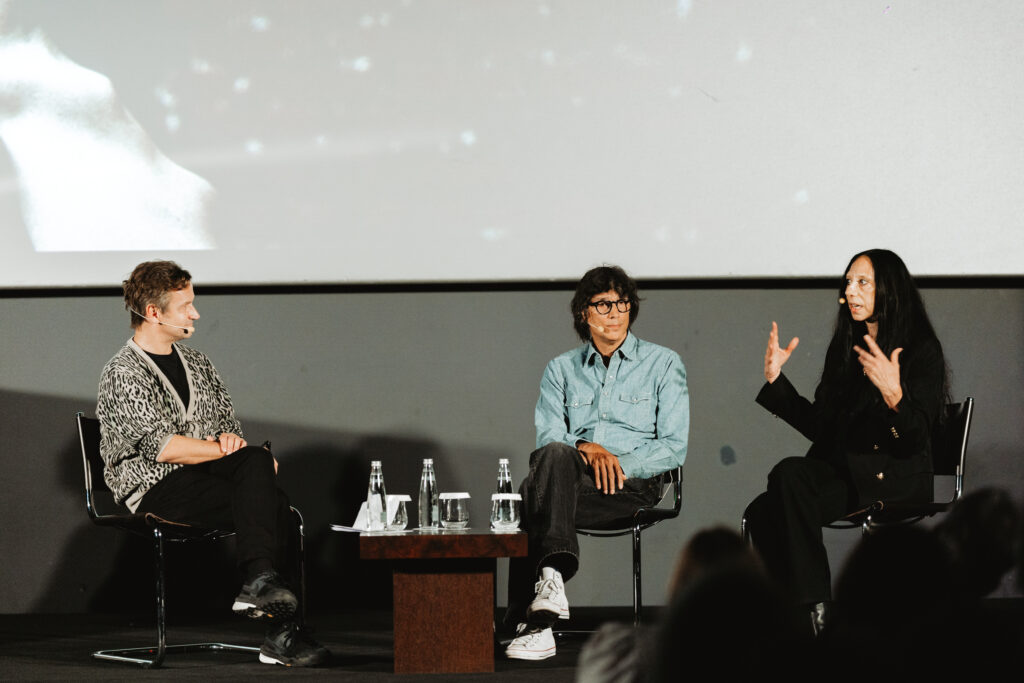
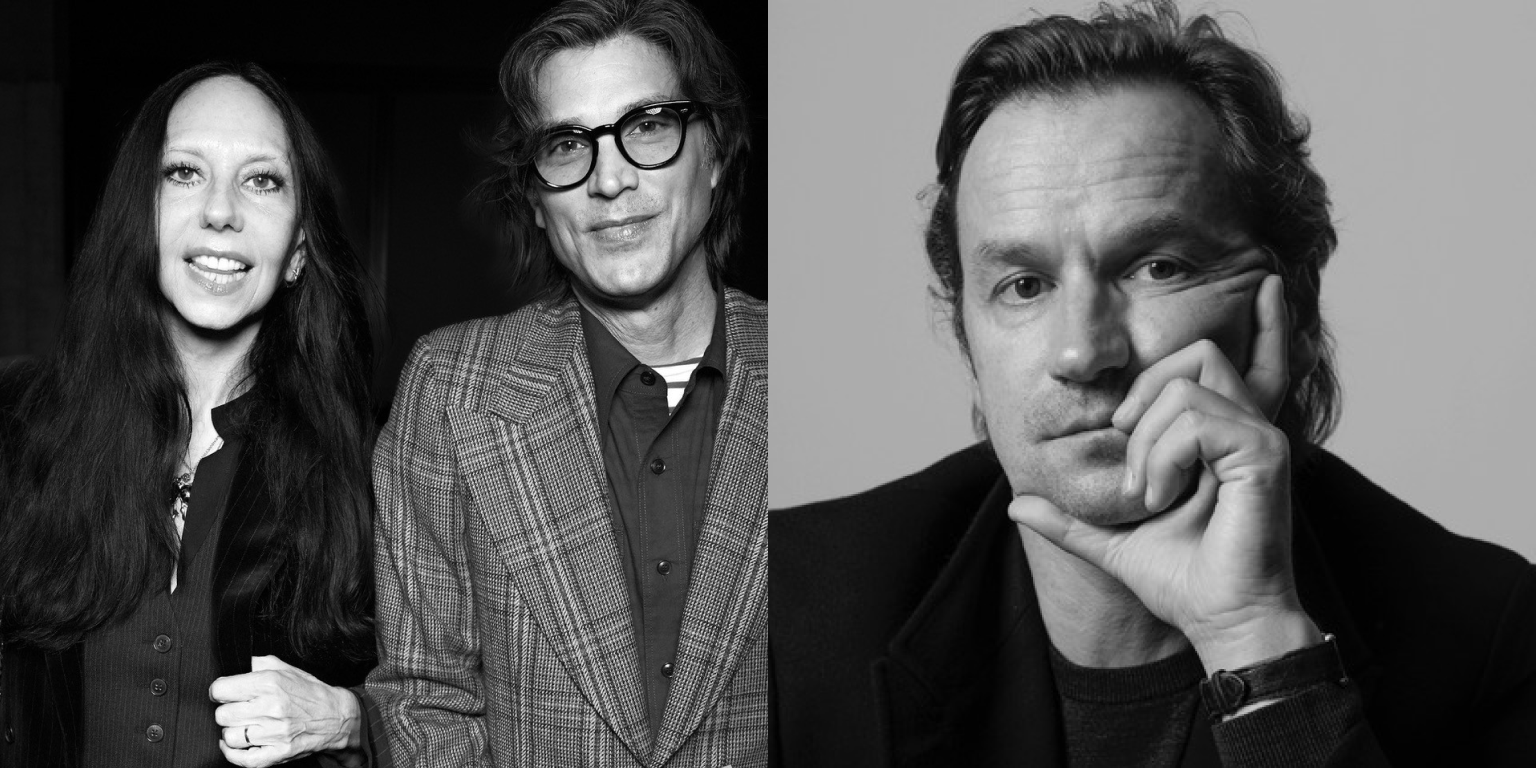
Inez van Lamsweerde Hello.
Timothée Verrecchia Hi, everybody. Inez & Vinoodh, thank you for being here. So I think we should jump right into it. You guys have been playing with what’s real for a really long time.
Inez van Lamsweerde We have.
Timothée Verrecchia And I know that in March, you’ll be showing 40 years of work. Can we get the images, please? Here we go, here we are. So, in March, I’ll be showing 40 years of work at The Hague. This is a very big moment, not too overwhelming. Are you ready?
Inez van Lamsweerde It’s exciting. Very exciting.
Timothée Verrecchia And you really are pioneers in manipulating the real. You know, your images are really always in this kind of gray area between the real and the unreal. Can you speak to us a little bit about how this art form, this language began?
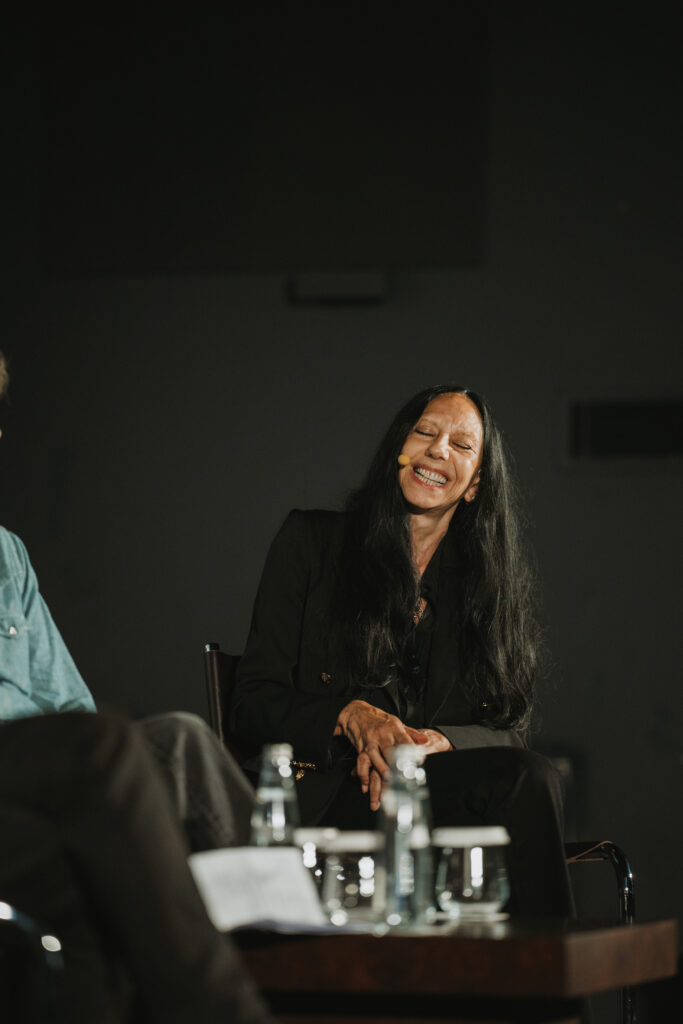
“We are obsessed with cutting through time. And having this kind of second chance at the decisive moment, which is such a thing in photography.”
-Inez van Lamsweerde
Inez van Lamsweerde I think our main aim in our work is to kind of present the conventional promise of photography as a purveyor of truth. I think that’s what’s at the bottom of every image we make, or one of the things that’s at the heart of every image we make. We are obsessed with cutting through time. And having this kind of second chance at the decisive moment, which is such a thing in photography. And the idea of photography being a reflection of what’s real and the truth was never the case, but certainly now it’s absolutely not the case. But when we started using digital manipulation back in 1991.
Vinoodh Matadin On the quantum paint box before Photoshop. It was used to, you know, for advertisement in those days, just to straighten cigarette packs and change the wheels in a car. And we were one of the first to decide to use humans and alter them.
Inez van Lamsweerde Yeah, because like you see it on this image here, which is one of our seminal images where we photographed ourselves kissing and then on the computer, we took Vinoodh’s face away and replaced the void with the wall behind me. In this aim to kind of show, use the surface as a visualization of an internal state, of a psychological state. In this case this picture is about loss, about love, about the one violently without the other and how this kind of creates a new physiognomy. And I think our obsession with faces, bodies, gestures all translates into… the work we do. It goes from studying the way an eye sits in a socket to completely altering a body to show what’s inside someone.
Timothée Verrecchia Right, and so much of it is really about inventing a visual language, but it really is about, to your point, reinventing or re-appropriating time, this concept of time. You always sit in this weird kind of ambiguous zone between the moment and the timeless.
Inez van Lamsweerde Exactly, and I think that’s what’s been so incredibly inspiring with the possibilities of the computer and digital manipulation. It always felt like, wow, we have a second chance or a third chance or a 40th chance to actually go back in and change things and show stuff that you can’t see on the outside. We can see when someone’s maybe shy or embarrassed, like you blush, but that’s about it or… You get really skinny when you are in a breakup or whatever, but it’s not like, other elements of human psychology, and we are really, really interested in that in every way, like whether we are making work like this that lives in the art space or whether we’re in the fashion world, there’s always… You know, that idea of sort of subverting time and cutting through the surface is really, I think, what we’re dealing with. It’s a flat image, it’s a photograph, but we gotta try to go through.
Timothée Verrecchia But it’s a living thing at the same time. The process really never ends.
Inez van Lamsweerde No, no. I mean, 40 years.
Timothée Verrecchia Right, but as you were showing me the installation, we were struck by how it’s really timeless, the body of work is timeless.
Vinoodh Matadin Yeah, we took time out of all the pictures, so it’s 40 years of our work, but if you look at the exhibition, you have no idea which image was taken 40 years ago or which one was taken yesterday. It’s also the way we use the manipulation. It’s sometimes so subtle that you don’t know. And we always confuse people because a lot of people think everything is manipulated. In what we do, most things are just straight out of the camera, and we don’t change anything. But then, people because of how they grow up with our images, they think there must be something. “They did something”, and we didn’t do anything.
Timothée Verrecchia Right, and you were telling me about the first reactions to those manipulated imagerings.
Inez van Lamsweerde Yeah. This series, too, is one that we made in 92, when this whole series is where it really is about showing an internal state, an emotional or psychological side, and altering the physicality because we can. And I think it sort of set the stage like here, for instance, we changed their hands for a woman’s hands. Kind of along the lines of what Lou was describing yesterday, how a hand is something that’s tender and touches, but also something that is violent.
Vinoodh Matadin It’s a weapon at the same time.
Inez van Lamsweerde So there’s ways to do it now. I feel like I think.
Vinoodh Matadin And also that we photograph the men in a very passive way. Like in art, men are always very strong and we say, let’s do the opposite. Let’s make them very passive.
Inez van Lamsweerde And vulnerable and more in like a feminine position because specifically, manhood has almost more problematic things attached to it where still today I feel like a man has to be like, not cry, it’s always associated with violence.
Timothée Verrecchia The social representation, right, the social attributes.
Vinoodh Matadin But we also noticed when this whole internet started, we were like, oh my god, if everybody’s going to be on digital, you can be anything. A boy can be a girl.
Vinoodh Matadin Yeah, you can be anything, so gender will be very fluid for the future.
Inez van Lamsweerde And it is. It turned out to be.
Vinoodh Matadin And now with AI, it will be even further.
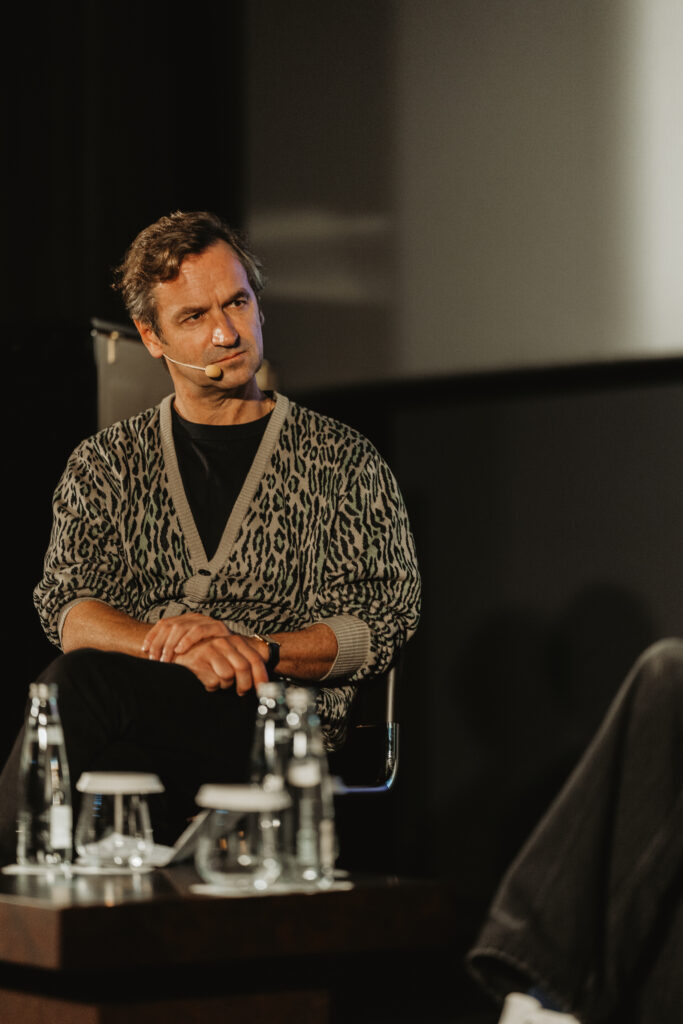
Timothée Verrecchia Well, that’s very interesting with your body of work, because again, because it is timeless. But you have preceded so many of those trends. Again, we talked about manipulation of imagery. We’ve talked about the questioning of body, gender, and physicality. How do you interpret everything that we’re living through in the way that, for instance, you know people are transforming their bodies and people are transforming imagery, people are transforming their own truth. We’ve talked about all these things, so for you who really preceded the internet age, the digital age, how does that affect the work and the way you foresee the work going forward?
Inez van Lamsweerde I think it’s good and bad, I guess. There’s two ways to it and I think that’s a part that also plays along in our work a lot, this idea of ambiguity and duality and being equally attracted to the beautiful and the grotesque at the same time. And, um… There is a lot to be said, I feel, for the current openness about body transformation on every level. And I kind of love that. I love that, at the moment, plastic surgery, for instance, is no longer seen as something you don’t talk about. That’s a taboo. Um, uh.
Vinoodh Matadin Life extension?
Inez van Lamsweerde Life extension.
Vinoodh Matadin Putin was caught on an open mic saying, I want to be 150 years old. This is the dream now.
Timothée Verrecchia The improvised hot mic.
Inez van Lamsweerde Yeah. So anyway, I feel like there are great sides to what’s happening currently. At the same time, I think we get fooled all the time and we can’t tell what’s real or unreal anymore. And we all, I guess that’s why we’re all here. We all feel that everything in real life will have more and more value, I think, live performance, talks like this.
Vinoodh Matadin Live music.
Inez van Lamsweerde Live music will really…
Vinoodh Matadin Well, I think there will be two roads. There will be the one person who will go back to small things, like traditional, like real materials, like real music, real food. And there will be another push for really AI. And that will be…
Inez van Lamsweerde Simulated.
Vinoodh Matadin Simulated or you don’t know what real and unreal it will be.
Inez van Lamsweerde And people will embrace it too, and why not?
Vinoodh Matadin And somewhere in the middle we have to come together.
Timothée Verrecchia Does it even matter what’s real and what’s not real? I mean, it’s the actual definition of reality. I feel like this has been really this at the core of everything that you’ve done for 40 years, does real matter? Has it mattered to you?
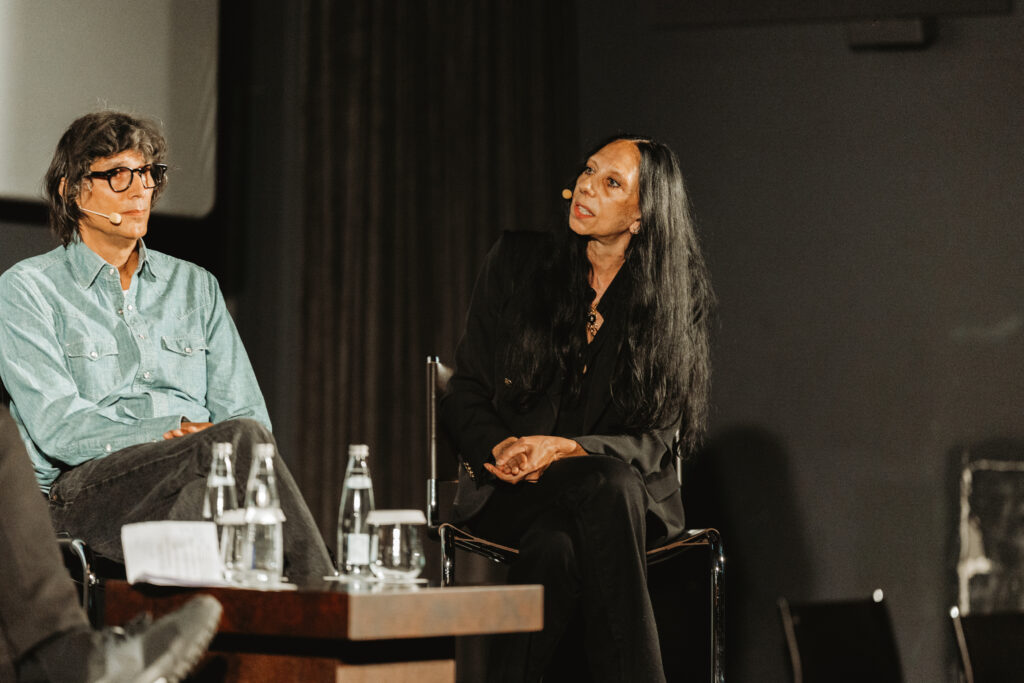
“Fashion photography is basically telling you that the road to happiness is through glamor. So, it’s showing you a way of… You will have this happy life if you buy this bag because you’re like this girl in this picture.”
-Inez van Lamsweerde
Inez van Lamsweerde To us it doesn’t, I mean to me it doesn’t. I mean I think I’m actually not so interested in reality and I like being able to manipulate it and to change it and if you think about our life as fashion photographers, fashion photography is basically telling you that the road to happiness is through glamor. So, it’s showing you a way of… You will have this happy life if you buy this bag because you’re like this girl in this picture. And that’s the aim of fashion photography and there’s no kidding about it. This is the reality of fashion, but it’s staged photography. Nothing’s real and that is the thing that is always so fascinating to me when people say, oh, but it needs to feel raw and real and I’m thinking. No, we’re here. There’s hair and makeup done. The styling is done. We’re in a set, or we’ve blocked off a part of New York City to shoot at. Nothing’s real. There isn’t any reality in what we’re doing. We are just creating things to inspire people, and either to inspire to buy the bag, which is what we are getting paid for. There is no kidding around it. And it’s a great clean negotiation. It’s like, I make a bag, you shoot it, I’m selling the bag. Done.
Vinoodh Matadin But in the art world it’s exactly the same. You have to seduce people to sell your painting.
Inez van Lamsweerde Yeah, and it’s a beautiful thing. I think this beauty is so powerful and it will transcend everything and everyone. And I think that’s where, for us, we feel so lucky. Look at our life. We are 300 days a year, approximately, on set with an incredibly beautiful human. And I’m always like, but look at this, I can’t…
Vinoodh Matadin Not only beautiful, but also most of the time very interesting.
Inez van Lamsweerde Interesting, amazing, gorgeous, but in any case, I get to look at Malgosia’s eyes for a whole day, and I’m like, look, not everybody has that chance, and I think that’s why people come to museums, they want to see something beautiful, they want to be overwhelmed by it, and i can be overwhelmed, but sometimes… We photographed someone and I’m just like, I actually don’t even have to take the picture. I’m so happy just looking at this person. And I feel like it’s not so much about, oh this person is beautiful, this person’s not. It’s about finding something in someone that kind of overwhelms you in a way.
Vinoodh Matadin It’s almost like emotion. To find a really strong emotion will be the most important thing in the future. True. Don’t you think?
Timothée Verrecchia Emotion and the energy, also the energy. I mean, I’ve had a chance to see you on set. It’s really how you feed off of the energy and you start dancing around it and try to capture it. But to go back to the fashion industry, I think so much of the work that you’ve done was precisely to question the cliches and to question the pervasiveness of perfection and this kind of, this imagery and these myths in the fashion history. Do you find that that is still possible or if not, if not the fashion industry, what are some of the creative spaces that you like to explore that you find that are welcoming this kind of ambiguous language?
Inez van Lamsweerde I think it’s still possible and I think it’s there and it was the thing that we, because we started as artists sort of on the outside of the fashion world.
Vinoodh Matadin Well, we were always outsiders, and I still think we were still outsiders. We don’t belong in the fashion world, we don’t belong in the art world, and we don’t belong in the film world. We observe people, that’s what we love to do.
Inez van Lamsweerde But at some point we decided to take a step inside, let’s say, the fashion world gives us a chance to talk about all its norms and standards and preconceived ideas and play with the codes of clothes, because that’s the other thing that people underestimate. A lot of people say to us, like, oh my god, fashion is so superficial. And I’m thinking, well, you get up in the morning and you’re putting something on and you’re talking with your clothes. We’re all talking with our watches, you know, we’re like, I’m wearing…
Vinoodh Matadin Sneakers nowadays.
Inez van Lamsweerde Like, what are you wearing?
Vinoodh Matadin And nobody really studied it.
Inez van Lamsweerde It’s a language.
Vinoodh Matadin It’s language. It comes from somewhere. And somebody decided it for you. And you just copy it. You took it from your father, or your mom, or somebody you were admiring. But you just copied it. And you don’t even know where it comes from.
Inez van Lamsweerde But we all make a decision when we get up. Like today, I have an interview for a job, so I’m dressing this way. Or I’m hanging out with friends and she’s always wearing something sexy, so I am gonna wear something sexy. So it’s like a negotiation constantly. And so we always say, but it’s language, you talk with it, and that’s what makes it so interesting because a white shoe in the 80s meant something very different in the 90s. Very, very different language on just the one white Manolo. So I think that’s what’s interesting us all the time, is this idea of like, okay, what does it say now? What does it say about culture now? What does it say about humans now? Who do we want to be at this moment? And fashion cycles through it. And for us, it doesn’t.
Vinoodh Matadin Fashion, like everything cycles.
Timothée Verrecchia Culture, right?
Inez van Lamsweerde Culture, yeah. But to us, it’s the work we make with the show, especially in this 40 years retrospective. We’ve looked at, again, at all our work and then kind of figured out, like, okay, the stuff that we still consider work that needs to be on the wall is maybe not the work that we make every day. It’s really, there is a special kind of attention that then shifts. Something into a longevity moment that brings it like Vinoodh described where time is no longer a thing. It’s not fall / winter 2023 anymore. It’s like a work that stays. And it’s an amazing life. I think the coolest life is when we have each other. And I feel like people say, “Oh, you work together. I could never work with my husband.” I don’t know how else to live.
Timothée Verrecchia I mean that’s probably the most real thing I’ve seen in the last few months is the love that you have for each other, I mean these are couple goals.
Vinoodh Matadin With us, love is the most important word.
Inez van Lamsweerde Yeah, of course.
Timothée Verrecchia And I see how it really transpires in all the work, but…
Inez van Lamsweerde But our body of work is a testimony to our love, I feel like. I feel it’s not, people say, oh, but do you have time? You know, Twig’s, she asked this the other day.
Vinoodh Matadin To be intimate.
Inez van Lamsweerde Do you have time to be in it? But I’m like, look.
Vinoodh Matadin We’re constantly intimate.
Timothée Verrecchiaa And I was just saying being on set with you guys, it’s like, we’re watching you guys dance, it is like one couple dancing, it was incredible.
Inez Okay, well, there is 40 years of work together that shows this intimacy and the immediate connection we create with the person in front of us, the sitter, the person that we’re photographing. And I think that’s the other thing for us is so important is the immediate establishment of trust. And I think Malgosia talked about that too. It’s like you as the model or as the sitter you surrender. You have to, otherwise it’s not a good image. It will never happen.
Vinoodh Matadin And we surrender too, like if we are like an empty vessel, we just absorb your energy.
Inez van Lamsweerde And get it back out. Yeah.
Timothée Verrecchia How do you deal with with moments when the energy doesn’t come through?
Inez van Lamsweerde That never happens.
Timothée Verrecchia It’s never happened to you on set, where the energy doesn’t…
Inez van Lamsweerde No, maybe once when someone was an asshole.
Timothée Verrecchia Or negative energy, right?
Inez van Lamsweerde We’ve only shot one asshole in his whole 40 years.
Timothée Verrecchia That’s a pretty good statistic.
Inez van Lamsweerde Yeah, it was okay.
Timothée Verrecchia Statistically, that’s pretty good.
Inez van Lamsweerde It was good. And we still talk about it. One every 40 years!
Vinoodh Matadin And thank God, all his colleagues were thinking the same thing.
Inez van Lamsweerde Yes, it wasn’t just us. But I think the wonderful thing is that this exchange of trust, and like Vinoodh said, for us, this canceling out of your own ego is what we live for. Sometimes it’s only 15 minutes that you have with someone, and that’s what we do.
Vinoodh Matadin And we see it, and we also see it disappearing. So it’s there, and then suddenly it’s gone. And then you can better stop, because it will never come back.
Inez van Lamsweerde Yeah, you have it. It’s there, and it’s, I don’t know, there’s this idea of, it’s a seduction, it’s a conquest, it’s an exchange, and it in our mind, we try to lift people up. I think like Jeff talked about it yesterday, it’s this being of service that we see it as lifting the person up that we’re photographing and there’s people that are saying to us like, can I please have the audio tape of this session because it’s so motivational and I feel so good now. Can I have that every morning? But it is like that for us, like we get obsessed with someone and find like, if I would take your picture, I would, I’ve studied you now for a couple months, but I can see that your nose is what I love the most in your face, and the way your mouth sits.
Timothée Verrecchia It’s Italian, it’s an Italian nose.
Inez van Lamsweerde The nose is perfect, and then, what happens here between the mouth and the lips. So if I would take your picture, I would make sure I have that, but it would be the focus of the whole entire thing. It’s like within the 15 minutes, I would have the discombination in there.
Timothée Verrecchia You don’t always have two months to study people’s faces.
Inez van Lamsweerde No, but it goes fast.
Timothée Verrecchia Thank you. I mean, we have a mandatory AI question, but what I want to talk to you about is innovation, because so much of the work has been driven way before AI ever was on everyone’s minds about innovation. And again, your curiosity for technology, for tools, and how that feeds your creative process. What are some of the things you’re excited about? We don’t necessarily need to talk about AI.
Inez van Lamsweerde Um, you know, I love AI. I don’t know if you guys tried it, but put into ChatGPT a picture of your dogs and ask them to make it into human form. Guarantee you it is the best thing. It’s like my favorite thing and I’m recommending it to everybody. I think this is what it’s perfect for. It’s like umm… and it’ll ask you some prompts about the clothing and whether. Our dog Leo, whether he was intelligent, whether he’s intelligent, they’ll put glasses on. It’s great. Like I guarantee you, this is the best thing about ChatGPT. Do it.
Vinoodh Matadin I love her brain, you know.
Inez van Lamsweerde I mean, for that, it brings a lot of joy, and it’s this thing where we try to humanize everything, right? Like, objects, we want them to be humans. Dogs, we want them to be humans, and this need for being human, and…
Vinoodh Matadin I think AI is really great to solve medical problems, and I’m very excited, like one day we can talk to a tree. I can’t wait to talk to the tree and have a long conversation, you know. It is my…
Timothée Verrecchia I love your brain.
Vinoodh Matadin This is why I wake up and it’s like, let’s talk.
Timothée Verrecchia Have you identified trees that you want to be friends with?
Vinoodh Matadin Oh, totally.
Timothée Verrecchia Good.
Inez van Lamsweerde We have a whole garden full of them.
Timothée Verrecchia No, but what I was going to say is I think it also speaks to, you know, hearing you speak about ChatGPT and stuff, it speaks to the playfulness in your work. You know, I think that, again, I’ve got the chance to work with you. Everything is so playful and so light and so.
Vinoodh Matadin Well, there is no right or wrong.
Inez van Lamsweerde Yeah, we try to not be too stuck. We prepare very well, but then we just let it go. And then also with the knowledge and the confidence that later on the computer we can still do whatever we want to do. So it’s just so wonderful because you are just so in the moment and you react to everything around you, knowing that later there is this second chance that you can just go back in. And change things or augment stuff or enlarge things, take things away. I mean, I love taking trash cans out of the street when we’re doing a street shot. It’s very satisfying when that trash can can go. So there’s just from small to big, and I think the feeling of creating with a team is also very important to us like we are collaborators.
Vinoodh Matadin Yeah, we love to learn from other people.
Inez van Lamsweerde We are super into other people’s expertise, getting their input, creating something together. And we always say, like, we always envision our shoots where, you know, the sitter is here and then our whole team is sort of behind the camera and you see all these lines, all these arrows of energy going to the person. And it’s the most beautiful thing. It’s such an amazing moment where you’re all going like… wow is this idea of wonder and it must probably be funny, I don’t know, Malgosia and Lou can both talk to this probably about when you’re on the other side, and you see all of us go like, wow.
Timothée Verrecchia Seeing all those faces.
Inez van Lamsweerde But it’s the best feeling.
Vinoodh Matadin We are also the happiest if we work, we love working.
Inez van Lamsweerde We’re miserable when we’re not working, like a holiday really doesn’t work.
Timothée Verrecchia You had a three-day holiday this summer, right?
Vinoodh Matadin Yes, so that’s fine.
Timothée Verrecchia In France we call it a weekend.
Inez van Lamsweerde Yeah, like, what’s a weekend?
Timothée Verrecchia We have them every week.
Inez van Lamsweerde Not us, but we love it, you know, we’re the happiest when we’re creating and we have also the joy of seeing our child grow up in our world and be with us, travel with us, be on set with us and see him and his outlook on the world. There are a lot of people asking us “Oh, how does Charles see the world?” Or, “What is that generation doing?” And I feel it’s so interesting because he is studying sculpture at RISD, and so is his girlfriend, and their positioning of themselves is looking out towards the world. And I think it’s very different compared to all of us in this room. And where there’s a large focus on yourself, your own trauma, your own psychological things, where actually I’m noticing with his generation that they’re realizing, okay, the world needs help. And we need to talk about it. That’s what they’re focusing on in their art. Preserving nature, understanding our role in it, and what music can bring to an experience. And they’re much more about facing outward rather than inward as a research. And I find that extremely promising. I’m very inspired by his friends and his generation.
Vinoodh Matadin So we ask the question, this is our mantra to AI. Think human, think love, think nature. Repeat. And work on it.
Timothée Verrecchia Think human. Think love. Think nature. Wonderful. Thank you so much. I think it’s a great conclusion. Maybe we’ll take questions.
Vinoodh Matadin Thank you!