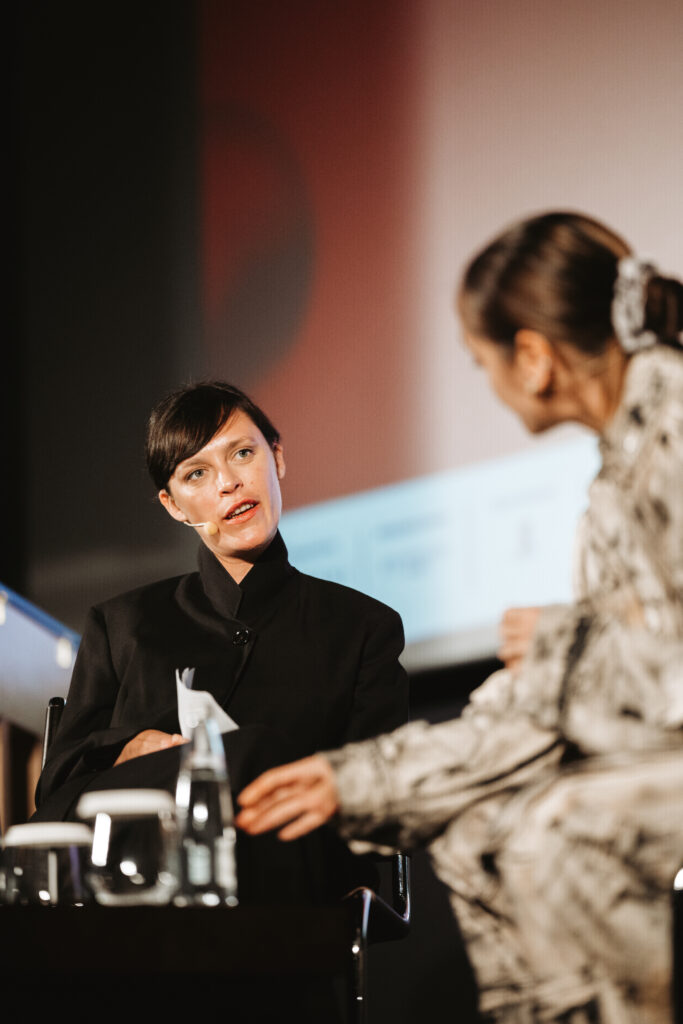
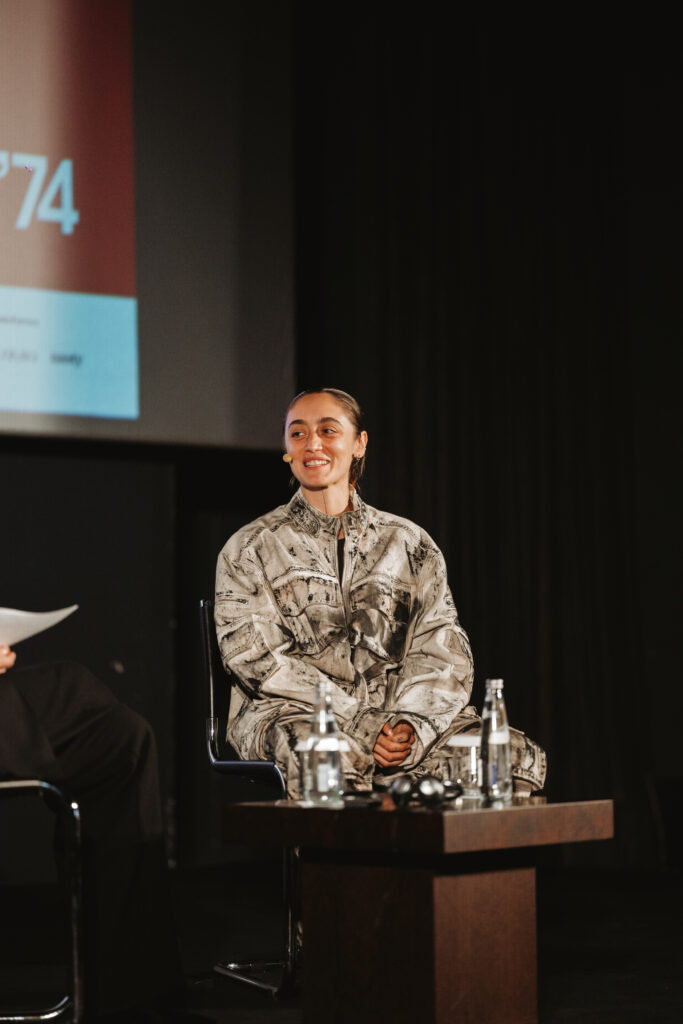
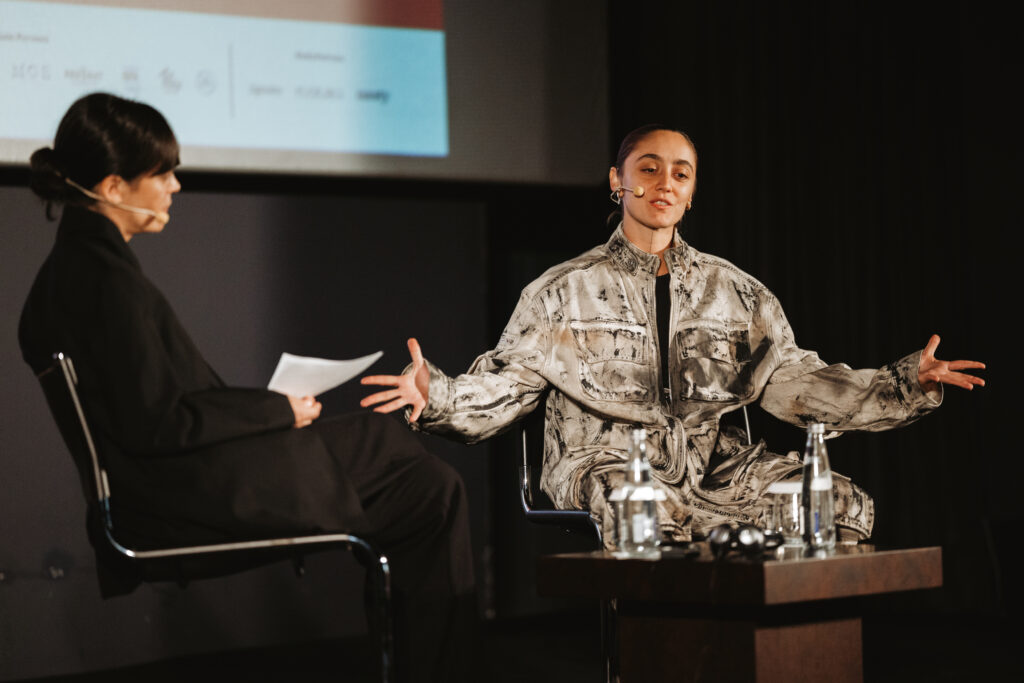
Ekin Bernay Hello.
Maria Abramenko Hello.
Maria Abramenko Hi everyone. First of all, of course, I’d like to thank all the team at the festival for having us, especially Nazy, Alphan and Demet, and obviously all the rest of the team that’s been working so hard these days, and that’s being an amazing experience, so pleasant, and it’s such amazing to meet all these new people and hear their voices and their thoughts. And thank you again for having us. Yeah, thank you.
Ekin Bernay Thank you. Thank you.
Maria Abramenko We met yesterday, to be honest, and I changed the whole question just 10 minutes ago. I’ve met her, and I’m very happy about this. Ekin is an artist who has spent most of the recent years in the UK, so I’d like to start talking about that. And given that you’ve been living abroad and studying abroad for a very long time, how does this time spent in the UK shape your professional career? And you’re back here for the last two years, correct? And how was it for you to get your education in another country?
“I think physically. Everything becomes very sensory. And every time the air has a different weight, every time, the brightness of a space, of a city, affects the way I look at things.”
-Ekin Bernay
Ekin Bernay It’s shaped me completely. It’s molded me into who I am. Well, I’m born here but I lived in London for 14 years and it was like that throughout my 20s and into the middle of my 30s. So it’s like the really shaping time of my thoughts and who I’m and what I want to do. So, It’s an interesting experience. I’ve moved a lot. Well, I’m a mover, so it makes sense, but I’ve moved around a lot since I’m young, and [00:03:34]every time you go to a new place it’s so much information for the moving body. [4.7s] Because I think physically. Everything becomes very sensory. And every time the air has a different weight, every time, the brightness of a space, of a city, affects the way I look at things. So all the visual and all the physical aspects of even pavements, for example, where like the pavement situation here is that you really, like, kind of doesn’t exist. So you have to go like, you’re hop hop hop, like even the way you walk, your pace changes. And so your rhythm, your inner rhythm changes. You have to be very vigilant. Car comes in, cat comes out, something might follow you. And then you’re like, oh, you are on the side, like scooters coming, you’re in this kind of choreography when you’re in Istanbul. It’s fast. London though, like this is like I want to just compare and go back to your initial question because London is like I was so surprised when I first got there like with like that dum dum dum, like and I was so slow there, in a weird way, because I was like, this is different, and they don’t look at you, nobody was looking at me. I’m trying to be seen, I had to build a whole identity there. So I think it definitely shaped me, changed me and changed my movement and made me even more of an outsider in so many ways. Like I’m always on the periphery. Now even more so because there’s always the sense of non-belonging.
Maria Abramenko Did you feel like an outsider in London as well or you’re speaking more about being an outsider coming back home?
Ekin Bernay I think both, because when I went, I didn’t fit in. And then I started feeling like home, like five years into it, one day I was like, somebody said five years, you’re gonna feel at home. After five years I’m like, still not coming. And then after like, maybe like into the eighth year, I remember very clearly, I was at this flat shared with artists and like a very creative house. I was like, on the sofa, I had this blanket on me, and I was, like, ooh, this feeling. I remember. I feel like home, like after so long. So it comes and goes, I guess, that feeling. But yeah, outsider in the sense of just, I’m comfortable in that position. It works for me.
Maria Abramenko I totally understand. I remember you were saying yesterday how beautiful it is to have a home, to have your own objects and to own them and to use them by yourself.
Ekin Bernay Yes.
Maria Abramenko Yeah, I totally get it. I mean that as well. However, yeah, my question is also like this kind of question, but also like how does it reflect on your work ? As if you’ve been in London, you choose certain things and you come back. And this is quite important for me because you were saying to me yesterday that there are certain rules in the performance, sort of unwritten rules in this country that are maybe different than the UK. And how do those little things of modifications for these or other reasons affect your work actually?
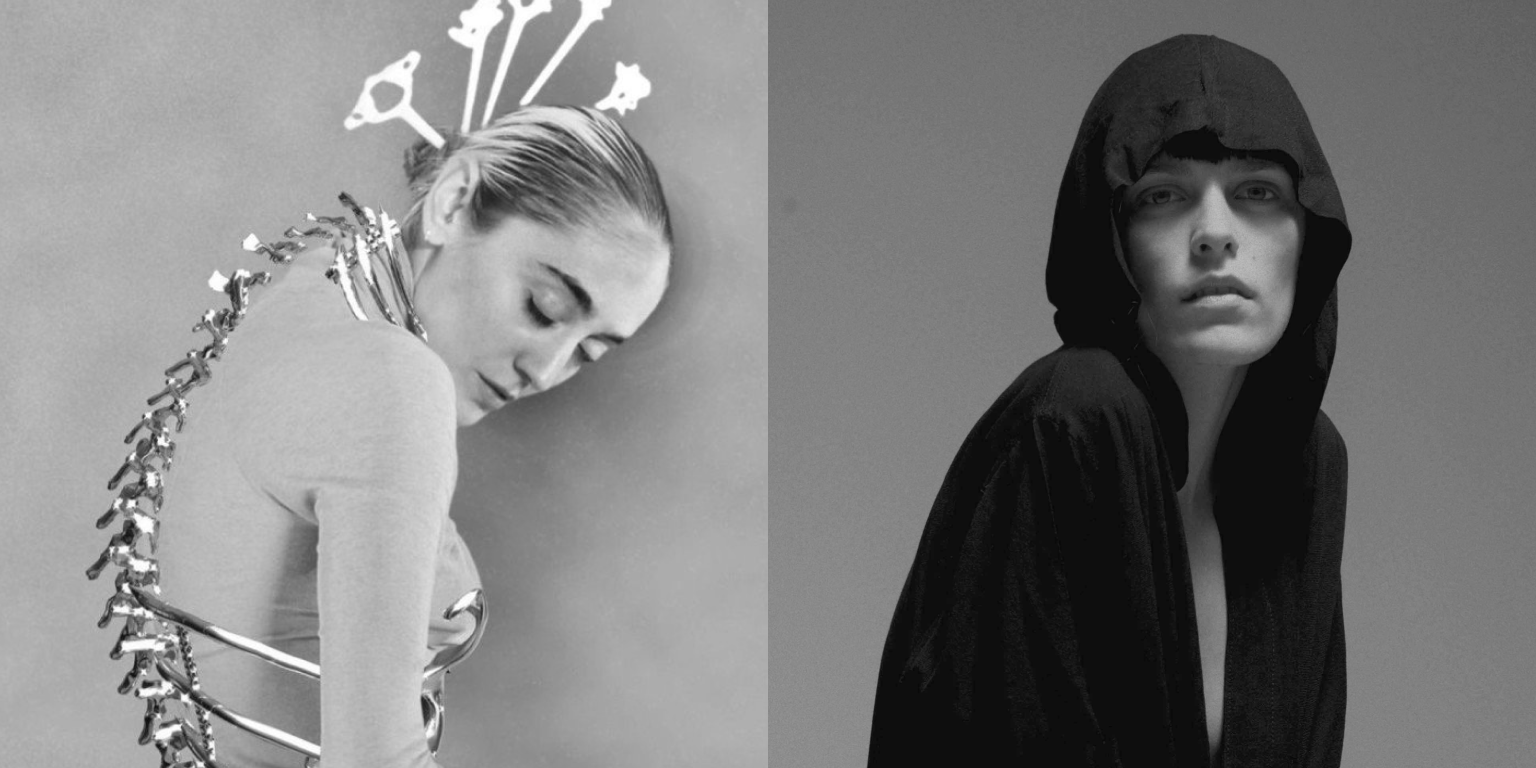
Ekin Bernay I think, in a way, it feeds it. So in a way, it helps to try to pull the two worlds together. But of course, there are certain ways to interact with the audience that work better in certain cultures. Because physically, in my work, sometimes you can watch it. But in most of the cases I would ask you to be involved in it, like where the performance cannot exist without your presence. [12.1s] So if, say, we’re doing something, say we are connecting, and we, like the performance we did with ISTANBUL74 a few months ago, maybe now, was this hard performance that I’ve been doing for a few years. It’s where you take the cast of your hands, like of your fist, and I’m in the process with you, and we’re just waiting for it to get really hard, like it’s a medical cast, and then you start to feel it gets warm inside, and then like first it’s wet, and then with the warmth it becomes something, and then we’re talking about our hearts in this moment, and then, you kind of like, you try to take it out, and it doesn’t come out, and you panic, and I’m like there with you. Then we talk about the separation and everything that it opens up. But when I do it here, say, with a Turkish audience, it’s a very different feeling than when I did it as a workshop in London, for example. Work is the same.
Maria Abramenko This is where I’m digging. Yes. I want to understand. Who are you there, and who are you here and if it’s the same person or is there a personality when you’re actually performing, or does it change like an act of a performance and then it is a consequence, performance change.
Ekin Bernay I think there is a persona, definitely, that I’ve become something. Yeah, I entered this place. That’s more free, but it’s my habitat that I’ve formed. So it’s like, I build the rules. So within these rules, I talk a certain way, and I welcome you a certain way and I’m like, whatever that needs, I hold, maybe sometimes I hold the group and I make them move a certain way. But it’s, it’s a zone. [17.2s] It’s another, yeah, it’s the most beautiful place to be in, and it’s like, I wonder if I was like that all the time, and sometimes I do this, it’s really annoying for people, like in social life it’s hard, because it’s a very intense personality, like that type of presence, it is a presence.
Maria Abramenko So would you compare this to acting in a way?
Ekin Bernay I don’t know, because I’m not an actor, but I’m not acting. For me, yeah, like, I’m not putting on anything. I’m just entering the other.
Maria Abramenko You.
Ekin Bernay Yes. Yeah, I think so.
Maria Abramenko Interesting.
Ekin Bernay And yeah, that is the healing. That’s where the healing and the transformation happens for me.
Maria Abramenko So it’s another very important topic in your career and whatever you’re doing, it’s the healing part. Let’s just talk about that a bit. But interesting that you’re speaking about yourself when you say healing. So do you heal yourself as well?
Ekin Bernay I’m failing. I’m trying to transform and change in these processes that I enter. I’ve figured out that if I’m not making, if I am not dreaming of the next project, if I don’t do that, then it’s dark and blurry for me, so I need to have this purpose. And I work towards that purpose, then it… becomes and when it becomes then I become and I’m like and then another level opens up and then it’s another mission.
Maria Abramenko Okay, so tell us about healing and how art can heal? This is a big question to myself. First of all, I’d like you to help me here. I’m not being pessimistic, but just it is what it is.
Ekin Bernay Well, because I’m a dance therapist, I studied dance movement psychotherapy in London and I practiced for like eight years clinically, mainly with children with autism and adults in mental health, mostly schizophrenia, and I would run groups. That was also, that’s where I could see, because dance therapy is so specific. Just so you know, it falls under the umbrella of all of the other art therapies. There’s like play therapy, music therapy, drama therapy and dance therapy and in those rooms it felt so real. I could see, not to say that you’re not healing, like I’m not claiming to heal in that process, but I could progress and I could see a connection from people who are otherwise quite disconnected. So just to host that space and to hold those circles and move, to do those dances, they were the most beautiful. It kind of makes me emotional.
Maria Abramenko Yeah, it sounds.
Ekin Bernay Yeah, it’s pure magic. And I can’t like the information from those eight years that my body has, like what’s been put on me, it’s, I can transfer it into anything. I can express what that was because of the things that I’ve seen. Because weekly groups, running groups, like sometimes the groups, they’re not meant to be this big, but because of yeah. Sometimes it was like 15, 16 people and it’s almost like, imagine a room where no one’s speaking the same language, but you’re talking, and you’re trying to find yourself. It’s a big group to hold, and also because of the voices, like people I work with also hear voices, so the voices are in the room with us, which was really interesting. But I’ve learned so much, and that has shaped, and that has changed slightly how I look at movement, and like what’s necessary, what’s not necessary in terms of when I make the choreographic work.
Maria Abramenko Okay.
Ekin Bernay So I’m really looking for the essence and the pure movement. Sometimes it looks really stylistic, like the rehearsal videos I was showing you today. It’s not there yet, but I’m going to clean it, and it will become something that’s very like, only what needs to stay needs to stay. As pure as possible. This isn’t a good example to tell you what’s happened in those processes. And this is why I believe, yes, through this type of practice, we can heal parts of ourselves. I believe in that. Not in the art that I create. I haven’t reached that power.
Maria Abramenko It made me think, you know, when you were talking about this Alejandro Jodorowsky practice that he had with people, I don’t know if you read this book about psychomagical acts that he was writing. So what you’re doing is very much a reminder of this. So people are, maybe he would go and operate on people and cut people, but this is all. We don’t know if it’s true or not, but it kind of healed people in a way. In a psychological way, and yeah, I’d like to know as well, because while you’re speaking I had this, the people in the room, you said they’re all different people, they suffer from different diseases.
Ekin Bernay Sometimes it’s a mixed condition. So sometimes you might have people with different diagnoses, but not necessarily all the time. Like that was because the same diagnosis can show itself very differently as well. But yes, in these homes that I went to, sometimes we had very extreme opposites of like people were like. That is really difficult to hold. Like, we might have someone who is working through addiction and what that brings, but then we have someone hearing voices here. So sometimes it becomes quite a high risk. And I think at the end of the eight years, I felt a little bit burnt out. So I was like, oh, it’s time for me to make art.
Maria Abramenko You are not doing it anymore ?
Ekin Bernay Since I’ve moved to Turkey, I’ve stopped the dance therapy. I do workshops, and in my workshops I try to bring in my practice from dance therapy and mix it with my movement knowledge and everything I know it blends in there. So every time I start a workshop, I start in a circle, like I borrow things from dance therapy but I don’t practice it like that, not right now, maybe after a while, I’ll go back to it when this stops making sense again, then I’ll switch back and forth maybe. I don’t know.
Maria Abramenko Do you have these stories of people that come back to you after the sessions and tell you that you made them feel better?
Ekin Bernay You see it because we report it, because we follow the process in that sense, in dance therapy. But even on the art side of things, sometimes through a performance, there will be a little drop of a moment where something might have shifted for the other person because we’ve experienced something that personally I experience every time I perform. So it’s putting the audience into that state, like, yes, like this is the most ideal thing would be to bring everyone where I go. It would be so, it’s so nice, it would be such a joy to have everyone be like in that body and feel, not meaning this body, but your version of what that state is. I’m trying to learn how to do that. And create the right atmosphere for that with every little thing in the room, you know? Like the pen that I choose in a performance is for a specific reason to take you somewhere, you know, like everything is little.
Maria Abramenko Okay, well, we were speaking a little bit about politics yesterday as well, and I’d like to ask you, as an artist, how important it is for you to be involved in the political situation of the country you currently live in? I’m not speaking about Turkey; it can be England, you know. I’m considering you as an international artist at this point. So, wherever you are in a place, do you feel a responsibility in this way?
Ekin Bernay I do.
Maria Abramenko To your practice, I mean…
Ekin Bernay I feel a responsibility on such a deep level that it’s beyond the current system that we are in. I was thinking about this, and I was like, ‘’How can I help?’’ I was asking the question before I started downstairs. How can I be of service to people? What’s the best thing that I can give … And this is when that journey started. [00:20:15]But I think my work is political on a very human level. Because I think we lack. And this is [00:20:29]my focus is to heal hearts and get us to love each other more. And I think this is the source of the… of everything. [12.1s] If everyone loved the way, I don’t know, like a healer loves. I think most of, none of this reality, none of this, we wouldn’t need to do that in my fantasy world. So I thought, okay, so expand hearts, like help, give space for people to express themselves so their hearts can expand. And the more hearts we expand, the better the world, like this is my, this is my hope. Yeah, so I’m political in that sense, but you don’t look at my work and necessarily see, like I’ve done performances about peace, yes, like very directly political. I’ve lied for like, I’ve, I’ve I’ve been this five hour long performance where it was like “Born, death and peace” and this is like a durational performance but then I thought like this is strong but we need to heal, open up and so yeah that’s my my work has become political for humankind.
Maria Abramenko Individually, more than ? Okay, I understand. Thank you, it’s been amazing.
Ekin Bernay But, having said that, you might watch the recent piece, this posthumous thing that I’m working on.
Maria Abramenko Yes, yes. Is it happening?
Ekin Bernay Yeah, it’s happening now.
Maria Abramenko So yeah, healing is one of the fundamental terms in your practice. How do you see the art of healing, like psychotherapy and, you know, connected to… whatever you do, like, you didn’t want to be called a performer yesterday and what I’m trying to, it’s like, are you a healer? If you’re not a performer, then how would you describe yourself, or would you even describe yourself?
Ekin Bernay Yeah, it’s hard. It’s really difficult to give that definition because it’s always changing. I’ve recently become really… I started calling myself a performance artist and I started hating the word performance, yet I still use it for now, but like live art, I like using this better, live art is good, but then, this is what I was telling you, then artists like… Any kind of tag, there’s a problem with that. Healer, are you a therapist? Are you this? Are you like that?
Maria Abramenko Yeah. Yeah.
Ekin Bernay And I cannot escape this. I do it to people. I’m like, I wanna get that information out with you as well. But, putting that aside, I think I need to, beyond the definitions, I need to create this thing where it all comes together, and I don’t need to even define it. It needs to speak for itself. But I’m working towards that. I really haven’t reached. The big picture is yet to be seen. Trying, trying, but simple, one simple thing, like just a little. I’m close, I’m close.
Maria Abramenko It happens a lot in writing as well, that there are some words that are used and abused by people. And some of the words are AI-related, and you could not use them, you become allergic to them. I don’t have examples now, but there are a few of them. So you read the text, and you’re like, “oh my god”, this word “no, please no”.
Ekin Bernay Yeah, like on curatorial texts, I feel like.
Maria Abramenko Yeah.
Ekin Bernay Sometimes it’s like this.
Maria Abramenko Anyway, let’s talk about the post-human project that you’ve been working on, which I find very fascinating. First of all, the theme of a post-human, I’d like to ask, how do you think that all of a sudden this post-human is so common sense to everyone and everyone is so interested in this topic?
Ekin Bernay Once I started focusing on it, of course, I really started seeing it more, and I was thinking it’s me, but actually it’s happening right now, we are changing, we’re becoming something else right now. So it’s the story of now, and I think that’s why it’s everywhere, it’s real.
Maria Abramenko Would you relate it to the AI era?
“We are changing, and it’s going to expand so much further than our bodies and physical limits. And because my work is to do with the body and movement and the skin, I’m just curious about where this is going, beyond the body.”
–Ekin Bernay
Ekin Bernay That’s definitely connected too, but recently, for example, my father had a hip replacement surgery. And just seeing the process of that, it’s insane to think that trans-human moment of taking a bone out and putting something else in… There’s a whole metallic, really cool titanium type of… He’s got a really cool hip. I don’t see it. But the design of the hip and the joint and what it is. We are changing, and it’s going to expand so much further than our bodies and physical limits. And because my work is to do with the body and movement and the skin, I’m just curious about where this is going, beyond the body. Because we’re going beyond the body, and what’s going to happen to movement then? What’s dance going to be? What’s post-human dance? What’s post-dance? That is also going to change.
Maria Abramenko How do you elaborate on those themes in your project currently?
Ekin Bernay So in this project I’m focusing on, I’m working on this 100-minute-long piece that is going to look at what’s happening right now. So it’s going to start with the system, then it’s going to go into mother-baby, the last baby on Earth, and then it’s going to go into the events where everything is blurry, and we are under smoke, and it’s almost like you can call it the protest, or you can call it war. Like it’s going to feel a lot of all those things and which is also happening right now, like all the wars that’s happening right next to us and then it will ascend and it will clean and it clear but I’m looking at everything that I see right now and trying to just… give a little summary on that in movement. So I’m gonna have 15 performers, and what I need to discover now is how the audience is going to move with us, because ideally we have to collectively do this. So I am trying to discover that now.
Maria Abramenko Interesting, you were mentioning before when we were just outside that how the shape of the process of your performance kind of taking shape during the making and I was just imagining a white canvas and a painter that actually finished it and this is how it works for you as well, so it begins with something and then it just ends up differently.
Ekin Bernay Yeah, yeah. It changes so much in the process because like say we rehearse for like eight and ten weeks but I’ve already started the work a year and a half ago in my mind and it’s always changing image then I start and put it on the bodies and everyone moves differently so them as their movement changes the collage in my mind of the hundred minutes is continuously changing it’s reshaping, reshaping and it becomes..
Maria Abramenko Doesn’t that drive you crazy?
Ekin Bernay I am crazy, yeah, this is why I’m like this. No, right now I feel the weight of it because I was thinking like when I was listening to you guys before. Was it like, why am I doing this to myself? Because I say I do this because I love it, and I love and it does help me, but every time I’m in a rehearsal process, like today I’ve come here from a rehearsal, and I’ve arrived and I was so stressed, like you saw me, and I was like, maybe like 15 minutes, I’m like, I’m arriving. Like I was still arriving 15 minutes later and you were like, go get some coffee. I’m like… It’s heavy. It’s beautiful, it’s heavy, it is inspiring.
Maria Abramenko It can be difficult emotionally, maybe, I don’t know.
Maria Abramenko Yeah, I think at times it is also trying to make it a reality with the restrictions and with the world happening around us. We just started rehearsals a few weeks ago and it was really important. We had one hour to do something, really important, let’s get to it, an earthquake happens so we have to stop everything. You know, like, it’s continuous interruptions and really difficult to, financially also do it, it’s really difficult to make live art.
Maria Abramenko I have another question, we only have a few minutes left, but I’m gonna throw the bomb, and I don’t know. Can anyone be a performer?
Ekin Bernay This is a difficult question.
Maria Abramenko Yeah.
Ekin Bernay It’s like, can anyone be an artist, basically. Yes and no. I tell you why because I feel like in my practice I’ve worked with a lot of performance lately, and there are just so many, you’ll never know why people are doing certain things. And if you can actually try to be accurate to describe it, art or less, or if it’s just, if they’re doing it just for fun or they’re just to be cool or to be in fashion or to be fashionable. And so there are a lot of things in there nowadays. I think back to the days of Marina Abramovic and you know, Ulay. Now it was a different performance, the description for this. And that’s why I’m asking. And I, yeah, I want you to hear what you think about it as a performer. It’s so hard to answer this, and this is when I heard it in my mind. I’m like, oh really difficult to answer because I don’t want to limit anyone’s hmm…
Maria Abramenko Freedom.
Ekin Bernay Yeah, like yes. So, yes, they can be. But for me, what touches me because sometimes… Like in dancing, everyone does the same movement, right? Like you do the same exact thing, and technically you can be perfect, and you can look at 100 dancers, and then there’s that one person that’s it, just they’re just glowing differently they just they just um carry something that although technically everything can be perfect, there is a different you, you know that person.
Maria Abramenko There’s just one person who is not able to dance.
Ekin Bernay No, I was talking about the opposite, like you would say, like in an army full of that you could be like… So there is a little touch of something, that otherworldly thing that is what I look for and I love. But of course, anyone, just do what they want as long as you’re not hurting yourself or others.
Maria Abramenko Yeah.
Ekin Bernay Make hearts, do it. But I understand what you’re saying, it’s fine, it is fine. I resisted TikTok, now I think it’s not so bad for young people, for people to dance like when it first came out, I was like “These TikTok dances”.
Maria Abramenko Britney Spears does it, everybody can, right?
Ekin Bernay Yeah, she does it amazingly. I love Britney’s songs. Yeah, I was resistant, but… free free free.
Maria Abramenko Amazing. Thank you.
Ekin Bernay Thank you. Thank you.